Monday, June 29, 2015

The Monsoon arrives

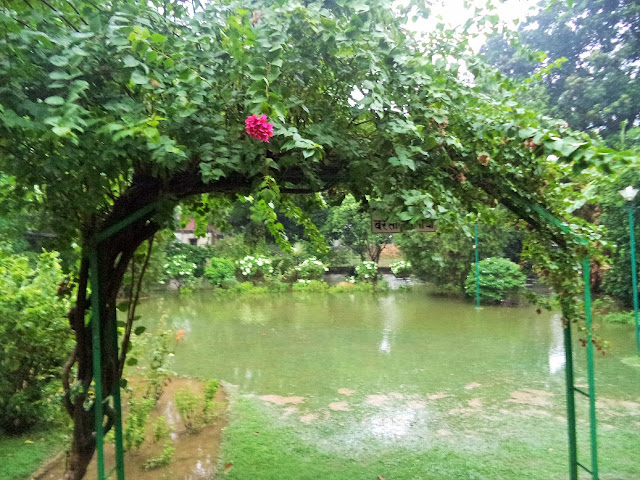
The monsoon arrived at Kachhwa yesterday. Of course, it was a welcome relief from the heat . . . However, it caused quite a lot of damage, including the cancellation of the Prime Minister Mr. Narendra Modi's visit to Varanasi . . .

As usual, it was quite pleasant inside the campus. Snaps of our home and the inundated garden . . .


Death by krait bite


Last Wednesday, early morning, at around 6:30 am, we had a patient wheeled in with a krait bite. Our JD, Dr. Krupa had her intubated in no time and Anti-Snake Venom was flowing into her veins in no time. 

However, as similar to many krait bites, she was taking her own sweet time to come out of ventilatory support. She had already received 10 vials of ASV. Then, ASV was still going into her veins even today. 

She was however not an easy patient. For some reason, we could not sedate her well. Midazolam and Haloperidol are the only sedatives that we use here. From Saturday morning, she was insisting on being extubated. In fact, we extubated her twice over the last 36 hours. But, she could not breathe even with the endotracheal tube inside. 

I saw her last alive at around 5:30 today (Sunday, the 28th June). I tried to wean her out of the mechanical ventilation (being given manually as our ventilator has malfunctioned). She went into desaturation. 

I received a call at around 11:30 pm today (Sunday, the 28th June) that she had stopped breathing. Our JD on call, Dr. Ao was already there trying to revive her. It was obvious what has happened. She had developed surgical emphysema. Most probably, she had developed a pneumothorax or her endotracheal tube developed a perforation in the trachea. It was too late. Her pupils were already dilated and fixed. 

If I remember, this was the second patient I encountered in my career who developed a surgical emphysema during mechanical ventilation and died. The first one who was a snake bite victim. 

I agree that our ventilation facilities are lower than the optimum for state of the art care of such patients. But then, we cannot afford high end ventilators where we transfer costs to the patients. 

Another note on this lady. On Saturday morning, the relatives had come saying that they cannot afford any more treatment. We agreed to cap the bill to 15,000 INR whatever be the costs involved. When I told that, their bills had already reached about 20,000 INR and they had paid only 9000 INR. They told us that the for the rest of the 6000 INR, they would have to borrow money. 

It was because they had come to us that the costs were so low. 

We lost our first patient of the season who came to us with snake bite. 

It is a major blow to our morale. We should not have lost her. He family had brought her within 4 hours of the bite which happened while she was sleeping. They had taken her to two witch doctors before bringing her here. 

Pray that the family would be able to bear the loss . . . 

Thursday, June 25, 2015

Issues of the Heart

Few days back, one of my senior colleagues shared an article on how deaths from heart attacks have dramatically come down in the United States. However, as I read it I know very well that only a minuscule of patients in our country who suffer a heart attack would ever undergo emergency angioplasty.

Angioplasty - that's the name given to the way they save the heart by opening the blocked artery by pushing in a catheter, inflating a tiny balloon and inserting a stent which will keep the artery wall patent. And this has to be done fast . . . very fast. 

Take the example of 2 patients whom I saw in emergency over the last couple of days at KCH. We worked fast to ensure that both the patients are referred to a higher centre. When we referred, the minimum we expected was that both the patients would be given Streptokinase to dissolve the block in their coronary artery. 

The first patient, a 38 year old mother of three with well documented anterior wall myocardial ischemia, was prescribed Aspirin, Atorvostatin and Clopidogrel and sent back home. 

The second patient was a 60 year old gentleman with typical symptoms of Myocardial Ischemia. He did not have typical features on ECG, but since the symptoms were typical, we referred him. Couple of days, the relatives came back saying that he had a heart attack with elevated enzymes. 

The guy was luckier as from the prescription, it seems that he got low dose heparin. 


There are 2 aspects. 

The first is the cost involved in treatment. The latter patient incurred a cost of 60,000 INR for treatment at the cardiac specialty centre he went to for a 3 day stay. No small amount for a middle class family, leave alone for the majority of my fellow citizens. 

The second aspect being the number of intervention cardiologists available in the country. I wonder if the total number of intervention cardiologists in the whole country is even a 4 digit number.

The third aspect is about where you'll be treated. The first patient was seen by cardiologists in a public healthcare set up. The second patient in a private tertiary cardiology care centre.

When we look at it - Yes . . . there's a lot of people dying out there or more than that getting debilitating heart damage due to ischemic heart disease, all because of high costs and non-availability of specialists. 

Well, the future looks bleak in a country which is still grappling with maternal deaths, children dying of diarrhoea and respiratory tract infections, tuberculosis and malaria. 

As for the time being the best option for us remains - 
2. Good exercise
3. Control of risk factors such as diabetes and hypertension. 

From the policy, we would need to see - 

1. If thrombolysis treatment can be authorised in primary care.
2. Short courses for medicine consultants in the public health secondary care institutions to do angioplasties.

Till those happen, the 3 cardinal rules to have a healthy heart remains the best option in the country . . . 

Clouds

Recently, I managed to click few snaps of the clouds during a flight . . .


Wednesday, June 24, 2015

Krait Attack - 2

Prameela went home after quite an uneventful period of admission in the hospital. However, Prameela was an eye-opener about why many snake bite victims are already dead when they reach the hospital.


Prameela reached last Sunday late evening. She was just alive. Gasping for breath with secretions flowing out of her mouth and nostrils, she would have been a goner if the family was late by another fifteen minutes in bringing her.

Prameela was bitten about 15 hours back, sometime before dawn. Her family members had woken up hearing her scream and caught the intruder which had bit her – a 2 feet long krait. Beliefs demanded that the krait be taken to a safe place and let free. The family was more concerned about setting off the snake free than about Prameela who was bitten.

They took the snake quite far away, deep into the jungle to release it which took them about 4 hours. By the time they came back, Prameela was not feeling well with feeling of something in her throat and abdominal pain. It was about 6 hours after the bite that Prameela was taken to a hospital.

At the hospital in the district headquarters, Prameela was administered intravenous fluids and some injections, the total cost of which was only 600 INR, which means she was not given Anti-Snake Venom. As Prameela’s condition appeared to worsen, someone suggested that she be brought to us.

We had to intubate her immediately. And she was in the ventilator for a good 48 hours. Thankfully, her recovery was quite fast.

Now, the worst part of any snake bite is what hit us next - The cost of treatment.

Prameela ended up with the requisite 20 vials of ASV. It was obvious that the total costs were much beyond the reach of the family. With tight budgets this year, we also were finding it difficult to write off bills. The family came to us begging for charity. We could not afford to give more than a 5% charity on the bill which was raised, which already gave her a charity of around 20%.

This is one of saddest parts of any snake bite. It is the rural poor who are the most affected. Since the last 3 years, the cost of Anti Snake Venom has risen by about 200%.

I feel that there are 2 solutions to the problem.

The first solution would be make ASVs freely available in all government facilities as well as designated facilities like ours which have a reputation for snake bite management. Closely linked to this would be efforts to decrease cost of making the ASVs.

Till that happens, patients such as Prameela would be dragged down the poverty hole by snake bites . . . 

Lessons learnt - 

1. TRADITIONAL BELIEFS CONTINUE TO BE A HINDRANCE TO TREATMENT OF SNAKE BITE VICTIMS. 
2. THE ONSET OF RESPIRATORY PARALYSIS CAN BE DELAYED BY AS LONG AS 15 HOURS IN KRAIT BITES. 
3. COST OF CARE IS A MAJOR ISSUE WITH SNAKE BITE CARE. 
4. KNOWLEDGE OF CARE PROTOCOLS FOR SNAKE BITE VICTIMS ARE VERY POOR AMONG DOCTORS

The patient I mentioned in the previous post, Alokita gave consent to be photographed and her story to be shared in my blog . . .

Alokita with her parents