Showing posts with label blood donation. Show all posts

Monday, November 18, 2013

Poverty . . .


Over the last 2 weeks, we had two instances where we were exposed to the stark reality of how poverty affects families, especially when it comes to healthcare. 

I shall start with the patient who I mentioned in my previous post on obstetric care. 

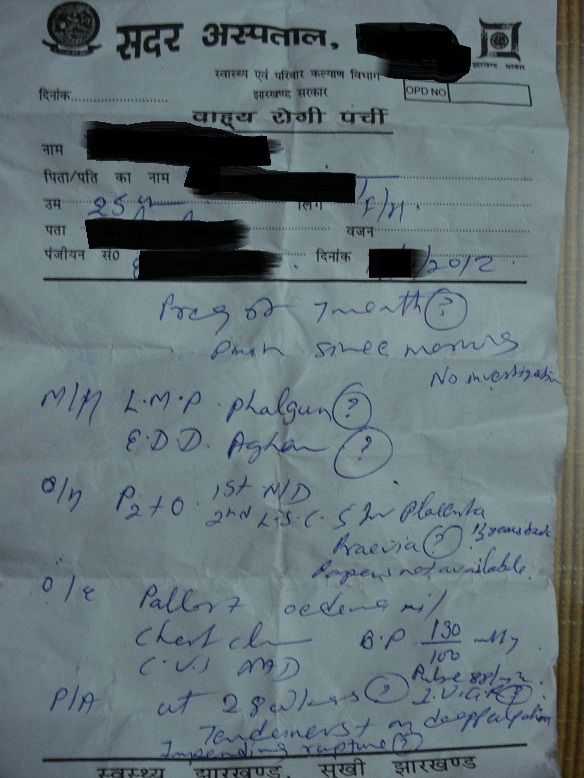
We shall call her Kkd. Yes, the lady who came in with a hemoglobin of 4.6 gm% and then had a hemoglobin of 2.6 gm% more than 12 hours after the delivery. I just got news from Acute Care that the relatives were able to arrange a pint of blood; almost 24 hours after she had delivered. 

Now, the whole question was about the reason why the family never brought her for delivery to the hospital. It seems that she was taken to the place where she had her antenatal check ups as well as to the nearest district hospital. She was turned away from everywhere. 

If we had got couple of pints of blood, we would have done off the Cesarian in no time. 

I believe that it was the good Lord's providence for her that she delivered normally. And then the family could arrange one pint of blood. Most probably, that is the maximum that they can arrange. 

The whole exercise of a Cesarian section with couple of pints of blood transfused would have resulted in quite a financial strain for the family. I realized it today morning when the nurses told me that they did not have money to pay for the medicines. In fact, we had admitted her without any advance. 

The relatives had been running helter-skelter to get some decent treatment for this poor lady. The fact was that almost all of their money had been spent paying for transport. 

However, while the process of getting blood was on, one of our nurses had caught bits of their conversation and found out that they were in the process of paying a huge amount to buy blood. 


In our nearest blood bank, the usual practice is to allot a pint of blood for 350 INR if the relatives are able to donate blood. However, when one cannot arrange a donor, there are processes quite unknown to most of us by which you can buy the blood from elsewhere at rates ranging from 2400 to 4000 INR. 

We somehow convinced the relatives to arrange a donor and get the pint of blood for just 350 INR. I'm happy that they heeded the advice. 

However, it was obvious that the family had run out of financial resources. 

All of us have failed them. From the very beginning. 

They had gone to a doctor in his private clinic thinking that they would get the best treatment. He/She had written quite expensive iron, multivitamin and calcium tablets. Which they brought. Instead of 30 tablets for a month, they had brought one strip (10-12 tablets) which was used for 2 months. 

They never got clear advice on what needs to be done when she goes into labour. No plan . . .

And even after she got admitted . . . unless our staff overheard the conversation about the blood, they would have spend much beyond their capacity and got the blood, which many a time is of very poor quality.

To be frank, for the poor, there is nothing much left in our country. They are the mercy of anybody and everybody. The question is whether 'the haves' of our country are listening. 

Leaving alone the subject of poverty . . . if there is 2 things which could improve maternal morbidity and mortality in this part of the country which is more of a problem for the poor and marginalised, I firmly believe that it is free availability of Iron tablets along with an awareness about the intake of these tablets and the second one - undoubtedly, UDBT.

Monday, May 27, 2013

Tale of 2 Anaemic Patients


Yesterday was my first Sunday first call duty of the year 2013.

Early morning, I was informed of a very complicated patient in the labour room. LD, a 26 year old lady has been in labour since Saturday early morning. She has been running from hospital to hospital trying to get some help. The problem was that she had a hemoglobin of 6 gm% and nobody was willing to take her. To make matters complicated she had been given injection pitocin elsewhere. She had a pregnancy couple of years back. The baby had died just after childbirth after she had attempted a home delivery.

She was O positive. Dr. Johnson tried to arrange some staff to donate when she reached late night on Saturday. Unfortunately, we do not have many staff with O positive blood group. There was only one option. Either the patient had to be referred or we had to do the surgery with a consent to do without blood which was not a easy choice. The family having had visited quite a few  hospitals before entering NJH had already spent quite a lot of money on her ‘treatment’. So, the question of going to Ranchi was totally out of question.

However, we decided to wait for blood to come.

It came . . . by around 11 am on Sunday morning. It had been a full 33 hours since she had been in labour. And she was into obstructed labour.

I opened and found the worst I had feared. The uterus had ruptured. The baby was alive but quite sick. The endometrium and placenta was grossly stained with meconium. The baby died by evening. LD lost quite a lot of blood. She is on the ventilator and fighting for her life.

As we were doing LD’s Cesarian section, rather laparotomy, in came SeD.

Frighteningly, SeD also had a history similar to LD.

SeD was brought by her parents. Her father, a wizened old man who had quite a lot of creases on his face was a sorry figure.

The history . . . SeD had also been in labour since the previous day. The family had been to many hospitals. She was also told that her hemoglobin is 6 gm%. And her baby was in an abnormal position. The nurses could not get the fetal heart. I was in a hurry.

I told them to push SeD into the ultrasound. I had a cursory glance at the fetus. The heartbeat was going strong and was a footling breech. No other choice than to do a Cesarian section.

I did not think twice. She was B positive. I send word to 2 of our staff requesting to donate blood. SeD was having very strong uterine contractions. I did not want SeD to end up with the same outcome as LD. Ebez George, our Project Officer and Dr. Basil, our Dentist were were happy to donate.

We did the Cesarian in no time. To my surprise, SeD had a twin pregnancy. Mother and babies are doing well. I had missed that in my ultrasound screening.

I wondered why we did not have a staff with O positive blood who could help LD and her baby. They would have done better. The baby would have been alive.

But, a terrible thing happened later. I went to see SeD’s father. He had narrated to me SeD’s sad story. SeD had also delivered 2 years back, but the baby had died soon after her home birth. When SeD got into her present pregnancy, SeD’s husband took her and left at her parent’s home and told them not to send her back if she did not have a live baby this time.

I was congratulating myself as I saw SeD’s father standing at a distance and was happy that I had good news.

I could only watch with horror the pain that SeD’s father’s voice echoed when he came to know that his daughter had delivered twin girl babies. The creases on his face becoming deeper as he pondered aloud, ‘Doctor saab, I wonder if SeD’s husband would come to take her back with the 2 girl babies’.


Please pray that LD would recover well and SeD’s husband feels proud to be the father of 2 daughters.

Tuesday, November 20, 2012

A Rupture Uterus and a nagging Snake Bite . . .


Two patients bothered me as I woke up today morning. 

The first was SD, a lady with a rupture uterus. SD had a Cesarian section couple of years back. But, as has been the case with many of our other patients, nobody told her that her next one should also be an institutional delivery. We had lost our previous patient, AD with a rupture uterus following a previous Cesarian section. 

SD’s pain started early morning yesterday. She was being managed at home. They decided to take her to the nearest district hospital, where she reached at around 6 pm yesterday. From the district hospital, they asked her to be referred here.

SD reached NJH at around midnight. It was an obvious rupture uterus with a dead baby. And the family was so poor. They did not know what to do. Till morning they did not go anywhere. They did not know what it took to arrange blood. To make matters she was also in sepsis.

Sometime around morning, couple of our staff agreed to donate blood. And we proceeded with the surgery.

The mother is doing well. We hope she will recovery without problems.

The best part about SD was that she had a referral letter . . . 


The second patient I was quite concerned about was Loric Singh, who has been in the ventilator for more than couple of weeks. He was on the road to recovery till today morning, when he started to deteriorate because of which he had to be put once again into the ventilator. 

I was thinking aloud of whether it could be something else which bit him.

That was when the bystander told me that the type of krait which bit him was of a very poisonous nature. I told him that I thought all kraits were of the same type. Then he told me that the snake had been kept safe with the family back in his village. A very common custom in the region, where the snake is caught and kept alive till the victim is cured or dead.

I enquired if it is possible to bring the snake.

The snaps of the snake are below.


The villagers know this a ‘ghadait’ . . . a coarser version of ‘krait’. It is the elder of the krait . . .  a very old krait. Some claimed that it was a different species.

However, on closer examination, it is evident that it is a krait.

However, according to many of our staff from the villagers, it is commonly believed that a ‘ghadait’ bite is always fatal. One of the elderly villagers told me that he does not know anybody who has survived a ‘ghadait’ bite.

Something new . . .  An elderly krait has a more potent and lethal venom than an young krait . . .

Would appreciate your comments . .  .

Wednesday, April 25, 2012

Syphilis . . . Forgotten foe . . .


Syphilis . . .The very mention of the term used to send shudders in patients and was the darling of medicine professors for quite a long time. It was described as 'the great imitator' by Sir William Osler. One of my professors used to tell that in the olden times, a post-graduate student of Internal Medicine was assessed by how much he knows about syphilis and it seems that the same status is presently enjoyed by HIV-AIDS. 


Well, why I started a post of Syphilis? Over the last week, I had two families diagnosed as having the TPHA test positive. None of the members of the family had any symptom. 


Here are their stories . . . I know there may be quite a lot you may want to comment on them, which I would like to hear . . . 


The first patient was MS, on whom we had to do a Cesarian Section after a complicated trial of labour elsewhere. Before the Cesarian section, MS was diagnosed to have a low hemoglobin and we asked her relatives to arrange blood. The husband had her same blood group and he was ready to arrange blood. Well, on screening of the donor we found out that he is TPHA positive. As a rule, we do not do TPHA on patients who come at term. We do them only for those who come in the first trimester.


Well, by that time the Cesarian was over. We tested the mother and the baby. Both were positive. They very well understood when we counselled them about the disease. 


When I rejoined NJH in June 2010, I had done a re-look at the blood tests we do. Since, almost all of our patients are poor, we were trying to cut down on the tests. We did not find any TPHA positives in any patient for almost 2 years. There were few HBsAg positives and no HIV positives among the antenatal patients. I decided to drop doing TPHA, the main reason being that quacks were quite prompt in prescribing antibiotics and therefore I came to conclusion that this must be the reason that there was no TPHA positive for so long a time. 


However, the protocol was do TPHA in the first and second trimester for all ante-natal patients and drop it for those who come in late third trimester or directly to labour room. 


I was contemplating on whether I should bring back the policy of doing TPHA for all pregnant patients when the next patient arrived. 


One of our antenatal patients who landed up in labour room was found to have a reactive TPHA which was missed in the antenatal period. There was nothing much we could do now other than to re-check TPHA. Unfortunately, the TPHA turned out positive and after the delivery the baby also was reactive. 


I called the father, a man in the armed police force. The fellow looked quite disturbed and a bit drunk. I told him about the TPHA reactive status of his wife and child. He seemed to be hardly bothered. The only thing he wanted was to go home ASAP. I told him that he also needed to get tested. He would have nothing of it. He told me that he had issues to attend to at home and therefore needed to get discharged immediately. 


We tried our best. Ultimately, armed with consent forms on what all will happen and accepting full responsibility if something untoward happens in the future, he was off with his wife and child. 


Questions I have in my mind . . . 

1. TPHA is expensive. Should I do it for all pregnant patients irrespective of when they come - especially when they reach Labour Room straightaway after Antenatal Care elsewhere. Most of the places, VDRL or TPHA is not commonly done. 

2. When I have patients like the latter, what do you do? They are high risk to the community. 

3. Could we have donated blood from the TPHA positive husband to the TPHA positive wife? We had a bit of difficulty getting blood after the husband was refused as a donor. Crossed my brain only now . . . it could have been done. 

Monday, February 6, 2012

Blood . . . rarest commodity . . .

Some time back I had put in a terrible snap of a blood bag which relatives of one of our patients had brought from our nearest district headquarters. 


Yesterday, we had 2 patients who had come in with hemoglobin values of around 5 gm%. 


The first patient, RK was the mother of 4 children and she was pregnant at 7 months gestation. She was from quite far away. She had suddenly started to bleed early morning. By the time she reached here sometime late afternoon, she was quite pale with no fetal heartbeat audible. Her hemoglobin was around 5.8 gm%. I informed the relatives that we could not do much without at least a couple of pints of blood. 


That was when the husband informed us that the unavailability of blood in the district headquarters was the reason for her being referred to NJH. In fact, the relatives wanted to know if they could take the patient to Ranchi. I was relieved - but later realized that she was continuing to bleed and the vitals were going down. But, without blood I did not have any choice. 


In the available circumstances, doing the 135 kilometer journey through bad roads was the best choice that RK and her family had. RK's relatives were well off and it was not quite difficult for them to take a decision to move ahead. I ensured that RK had two lines going in with intravenous fluids. 


As soon as RK left, came the next one. SD, another multiparous lady with bleeding since early morning. Contrary to RK, SD's family was very poor. It had taken them quite a long time to arrange transport and other arrangements to make it to NJH. SD had another episode of bleeding earlier last month. However, it had subsided within few minutes. I told the family of my predicament of not having blood readily available. 


The family expressed their inability to go any further. The husband told me, 'Sir, please do what you can. Even if the baby dies, please save the mother.' The blood results came. Hemoglobin of 5.3 gm% and the blood group was not matching with that of any of the relatives. It was quite late into the night and the relatives informed me that they would go to arrange blood as soon as it is daylight. I told them that it is a very risky plan. If she bleeds, we've had it. 


Meanwhile, we did an ultrasound. It was a low lying posterior placenta with abruption. The baby was alive. I could only pray that she would not bleed. Soon, she was into her labour pains. I was surprised that she did not have any bleeding. Within couple of hours, the baby was on the way. She delivered a dead baby. Thankfully, she did not bleed much. 


Blood transfusion facilities are a premium in almost all parts of rural areas of third world countries. In emergency cases, we keep few blood bags where we directly bleed for donation. It is illegal - but we do it so that lives can be saved. 


The present policies of blood donation are quite archaic and it becomes quite difficult in difficult areas such as ours. And since the last few days, we had run out of blood bags . . .  We are yet to get them . . . We could have managed RK if we had at least couple of blood bags, if not given her a better chance of surviving the journey to Ranchi . . . 


Wednesday, September 7, 2011

Charity - giving, giving and giving . . .

Couple of days back, one of my colleagues questioned me about our policy to going overboard to help patients get their lives back. The specific instance arose when I requested one of my staff to donate blood for SD about whom you can read here. Dinesh, the engineer here, readily donated blood – but I was taken aback when one of my closest confidantes chided me about the decision.

To recap things, SD was brought to our emergency in a quite bad state on 5th September morning. She had delivered a dead baby at around midnight and her placenta was stuck. She had been bleeding all through the night and into the day. Her hemoglobin was 1 gm% and she was sinking. With a AB positive blood group, the chances of her surviving were remote.
 
 
The fact is that SD is still alive. She has stopped bleeding. Her vitals are all normal. During my attempts of removing the placenta and from the history it was very obvious that the baby had been dead for days and the whole of the uterus was terribly infected. She has received two pints of blood so far of which the first pint was given by my engineer, Mr. Dinesh.
 
 
I clearly understand that volunteering to give blood in such situations is a very personal decision. I’ve known colleagues who weigh in the possibilities of a patient surviving before they donate the blood.
 
 
However, when I look it from the perspective of how Jesus looked at problems and their solutions – I am very much encouraged by the incident of the ‘Feeding of Five Thousand’ – which we read in all the 4 gospels in the Holy Bible (Matthew 14:13-21, Mark 6:31-44, Luke 9:10-17 and John 6:5-15). The most absorbing spectacle in the incident is the readiness of the disciples to tell Jesus on how little they had. And Jesus was looking at their readiness to share the little they had.
 
 
I’m glad that the Lord led us as a team to decide on giving this patient the one pint of blood which was the only thing other than our prayers which we could offer her to sustain her life. She has pulled through so far. We still do not know how things will progress – but we are encouraged by the unseen but the very much felt hand of the Holy Spirit that leads us each day.