Monday, June 18, 2012

Moneylenders . . .

The rural Indian hinterland is not complete without the active presence of moneylenders. They usually belong to the business class. They are know by different names in different regions of the country.


Today I was reminded of the chaos that a moneylender can bring about in the life of a commoner. I was sitting in the cool air-conditioned environs of my office, when a shabby looking young lad of about 19 years walked in. It was obvious. He wanted a concession for the treatment of his wife. 


GD, his wife had come about a week back after having been in labour for more than a day. And she was terribly anemic. We operated after the relatives arranged one unit of blood. Per-operatively we found out that the uterus was already ruptured. The baby was lucky to have made it alive, although a bit sick. 


The total bill for both mother and baby came out to about 17,000 INR. He had brought 10,000 INR. The baby's bill was about 2000 INR for which we gave full charity from Grace Babies. That left 5000 INR. I haggled with him to at least pay 2000 INR more. He fell to my feet and told me that he has brought all that he could afford. 


I asked him how he managed 10,000 INR. It seems he had taken it from the local moneylender.


To all of you who know the moneylenders in the rural areas of India, this may not be new. 


I asked him about the interest he would have to pay back. The calculations are astronomical and unethical. Let me put it in simple terms. 


The interest he is being charged in 10% per month. And he is paid 10% less of what is taken. 


Which means, if I borrow 100 INR, I would get 90 INR. If I pay within one month, I would have to pay 110 INR. If I pay the next month, that would be 121 INR. So you can calculate how much I would have to pay if I take one year to pay the money off. 


If my mathematics is correct, if I pay a 100 INR loan after 1 year, I would end up paying 314 INR. Imagine, getting a loan for 90 INR and paying back 314 INR. Recently, someone told me that there are some fairer moneylenders who take 10 INR per month for 100 INR. So, if you calculate that way, that would still be 220 INR after one year.


Imagine, GD's husband getting 9000 INR. He would be having to pay anything between 22,000 to 31,000 INR if he manages to pay back within one year. And there is the spectre of bonded labour which continues without much notice in most of our villages . . .


Poor families in rural India take such loans for three major reasons - agriculture (for purchasing seeds and fertilizer), unexpected ill-health and marriage ceremonies. Unless the monsoon rains fail, he is able to repay for agriculture costs. The problem is with the next two. 


My prayer would be that public health facilities would improve so much so that patients like GD would get the best possible treatment such that they would not need to approach facilities such as ours. Until that happens, I pray that we would be able to write off bills for patients like GD. . .


However, the Rashtriya Swasthya Bima Yojana is the best option available before us to bypass the moneylenders at least when the issue of unexpected healthcare costs arises. Unfortunately GD's family did not have an RSBY card.


We are proud to say that till today morning, we've had 868 RSBY beneficiaries accessing outpatient facilities (free registration and consultation) and 141 accessing in-patient care. The total costs should be around 700,000 INR of which we have got about 380,000. I'm glad that we could be of service to these many RSBY card holders in a short duration of not more than 4 months.  

Sunday, June 17, 2012

Fruit . . . Never seen before . . .

Couple of days back we were to Ranchi for official work. On the way back, we got to see a fruit we've never seen before. Locally, they call it, dou or dohu. After reaching NJH, one of the staff told that it looks like 'Anjili pazham' found in Kerala/ Tamil Nadu. Don't know what it is. Below are the snaps. Would appreciate if someone could help us with the English name for this . . .

The ripe fruits . . .

Another view of the fruits . . .

Shazia's expert hands peeling the Dau . . .

The fruit split through the middle . . .

The pieces. Looked like a mini jackfruit. Multiple seeds surrounded by sweet sourish pulp . . .
The seeds of the fruit . . .
I have been told that this is quite commonly seen in many parts of Jharkhand and is known by different names. It is not grown commercially, but picked from the forest. The not so ripe ones are used to make pickle. . . Well, looking forward for comments on this post . . .

Friday, June 15, 2012

Fearfully and Wonderfully Made . . .


I recently happened to get a copy of the 'Scientific American' that one of our visitors from the US had left in our guest room. And the cover story was about the Human Microbiome Project. I'm not sure on how old the discovery is. But it seems that scientists have found out that micro-organisms outnumber our cells by as high as ten to one. . . You can read more about it in this well written piece from 'The New York Times'.


Wow . . . It is hard to believe it. . . 


Can you believe that each of us are hosts to this whole group of bacteria, viruses and parasites living out of us. As someone wrote in an article - 'It is humbling'. As we have developed with science, we've been made to believe that we are always in control. Well, this piece of research which has been happening through about 80 institutions has burst this bubble. . . 

This also has lots of implications especially in the field of health-care . . .


Since the discovery of micro-organisms, we've always been thought that their presence is the cause of almost all diseases . . . We have research which blames them even for non-communicable diseases like Acid Peptic Disease and Atherosclerosis. Now, we know from this project, there are so many bacteria previously unknown, whose presence is required for our day to day survival . . .


Something which immediately comes to my attention is the prolific use of antibiotics in our country. Considering the findings of the HMP, the implications are unthinkable. 


Now, it becomes all the more easy to explain the high incidence of malignancies and non-communicable diseases in developed countries. Processed foods . . . lack of exercise . . . and much much more . . .they could all be killing the microbial friends in our body, making it more susceptible to disease . . .


Do not be surprised if your doctor is going to search if you do not have have a friend bacteria whose absence could be causing you regular attacks of common cold. 


And within the next 5 years, you may also be getting bacteria and viruses bottled and sold in syrups and capsules. We already have something called 'probiotics' being available - but this looks like only the tip of the iceberg . . .


I'm amazed how true it is when the Psalmist says in Psalm 139:14 -

I praise you because I am fearfully and wonderfully made;
Your works are wonderful,
I know that full well.


Wednesday, June 13, 2012

The Village Market . . .

During our visit to Takerma last week, we were fortunate to go through the local market at Tapkera from where the INJOT Project operates. The market is on once a week. It is always a privilege to see a local market . . . Yeah, there are lot of changes which have come in with advances in technology . . .But, still there was the rural flavor. Below are few of the snaps we could manage . . .


In the centre of the market are the memorials for the martyrs who fought for the Jharkhand state as well as those who fought against the Koel Karo rivers

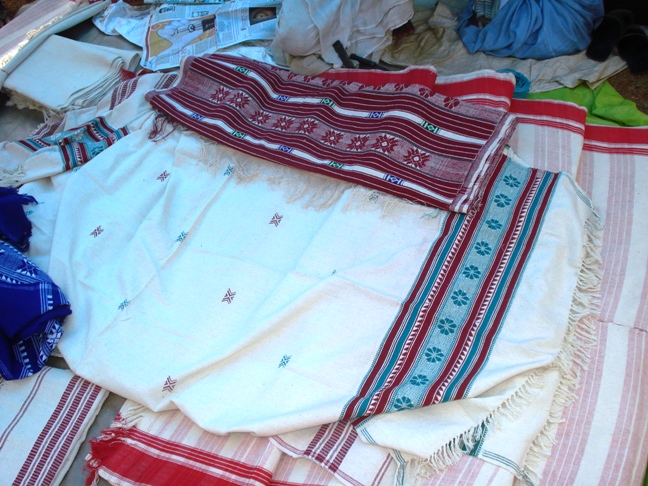
The traditional wear of the Munda tribe . . . The maroon and green colored ones are shawls whereas the red colored ones are saris traditionally given as gifts in weddings. . .

Table mats made from the same material . . .

The maroon colored cloth on the top is a bed-sheet which I purchased for INR 600.  Below that is a shawl which is specially used to make a sort of wrap-around for mothers to carry their babies while they work . . .


The market is famous for the traditional drum . . .

Torches (flashlights) . . . a necessity in the villages

Modern clothes . . . with eye-catching colors . . .

Was surprised to find dry-fish being sold . . .

Traditional fare made out of rice flour . . .

The only upper class travel which is cheaper than lower class . . .

Dinesh spied some really cheap knives for the hospital mess . . .

And modernity is here . . . See the solar panels. . . The largest one costs 4500 INR
I wonder how long will we see these traditional bazaars . . . especially scenes of the traditional wear being available like these. There is a lot of potential for such products if they reach the city and if the craftsmen are ready to innovate . . .

Tuesday, June 12, 2012

Mission Hospitals . . . Fading out . . .

As part of our visit to the Koel Karo region of Khunti district, we happened to visit a mission hospital long closed down. As part of the 'Injot Project', we were exploring whether we could revive the same . . . Few snaps from the place . . .

The front view . . .

Cracked walls . . .


Exploring history . . . That trunk looked quite old . . .

The writing on the trunk . . . I learnt a bit of geography . . . Had never heard of Trieste . . .


The backside . . .

The Tuberculosis Ward being presently used as a school . . .

Dilapidated area where patients used to cook food . . .

Another view of the backside . . .

Well in the campus . . .

The beautiful church near the hospital. . . The German touch is very much there . . .

Date trees with nests of weaver birds . . .
Well, mission hospitals had contributed quite a lot to Indian healthcare. Almost all of them were started by missionaries from abroad. I could not believe it when someone told me there were as many as 1500 similar hospitals functioning actively when the country got its' independence. It seems that there are only 150 now. And it includes hospitals which border on private hospitals in states like Kerala and Tamil Nadu . . . 


Hospitals such as the one we visited seem to be just waiting for someone to say the last rites . . . It's depressing. 


In the case of this place, there is so much a need for services in the region. The problem is with regard to personnel and funds. 


I know quite a lot of the 150 hospitals especially those in the North of the country. Almost all of them run on resources which are limited both in terms of personnel and infrastructure.


As we talked to the office-bearers of the hospital committee, it was sad that they did not have much idea about the history of the place. We could trace records till 1997. After that, no one knows much . . . 15 years . . . and it has been languishing. 


Well, the question is whether we are bothered . . .