Monday, June 25, 2012

Oxygen . . . Oops . . .

The end of last week, we were caught napping. And the cost was a terrible one. We had to refer 3 patients with eclampsia as we ran out of oxygen. We have 12 B-Type oxygen cylinders which we usually fill up once a week. Over the last 2 months, we had been filling them almost twice to thrice a week. 


Ultimately, our support systems collapsed. The truck which usually delivers the oxygen had a break-down on the way from Patna and the factory that supplies us from Ranchi (which is our alternative) was closed down for about a week on account of a local festival. Perfect recipe for making us look like fools. 


One of the 3 eclampsia patients was really poor. We had 3 oxygen cylinders. I was wondering about taking the risk and operating on her. Then we had 4 patients in the ward who were highly oxygen dependent. PD, the snake-bite patient, although off the ventilator needed oxygen to maintain saturation. There were couple of post-partum eclampsia patients who also needed oxygen. Then, a middle aged man with long standing duodenal perforation whom we operated couple of days back - who had been just weaned off ventilator. 


It was risky to take one more patient who had a possibility of being dependent on oxygen for some time. 


The poor family of the lady with eclampsia pleaded with us to somehow manage her at NJH. I consulted our Director. Managing such a sick patient without oxygen was unethical - - - they may not take her to Ranchi. After much pleadings, they relented. The family took her. I'm not sure where. 


Well, we need facilities for more oxygen supply. To give you an idea of how much we had been using up oxygen at NJH of late . . . the following statistics would help . . . All B-Type Oxygen cylinders.


2009-10: 256
2010-11: 170
2011-12: 305
2012-13 (April-June): 170


If this flow of patients continues, we would need to think of centralised oxygen supply. 


We look forward for ideas from experts about this. I'm not too sure. There have been proposals coming in from couple of service providers for centralised oxygen supply and suction. The total cost is about 800,000 INR (15,000 USD/AUD/Euros or 1000 GBPs). 


Another option would be to have oxygen concentrators. But, with the sort of electricity connections we have, it would be difficult to run and maintain. 


Talking about oxygen, I think it would be out of place if I do not mention about the opportunity which we could offer to doctors and nurses who are interested in critical care. With eclampsias, rupture uteruses, cerebral malarias and complicated surgeries becoming more common, we would do better with a Internist or Anesthetist managing critical care rather than a Public Health guy . . .

Sunday, June 24, 2012

Rains . . . Hooray . . .

There have been quite a lot of news about the possibility of a weak monsoon this year. 


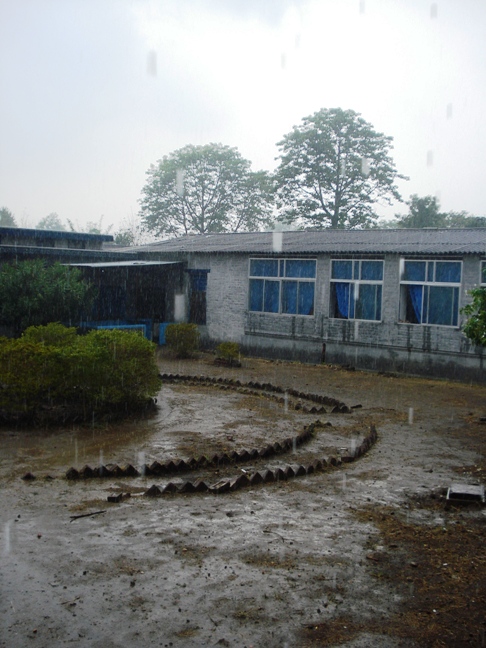
We praise God that it has been raining quite a lot since the last 4 days . . . Most of you know NJH as a dry place . . . So, below are the snaps with the rains . . . 


The first rain drops of the year . . .

Mud . . .

Roads becoming streams . . .

Water gushing down . . .

The road towards the church . . .

Stream starting to flow towards the pond . . .

Dinesh and Nandamani inspecting the flow of water from the campus towards the pond . . . We need all the water to go to the pond . . .


Again. . . Streams of water . . .

More streams . . .

And more . . .

Well . . . the pond has started to fill up . . .
The hospital team having a thanksgiving prayer beside the pond . . .

Yours truly in an adventurous mood . . .

Well, it's nowhere other than the pond in the campus . . .
Well . . . so, it looks like we would have a year without the fear of water scarcity. . . We thank the Lord for the blessing . . .

Saturday, June 23, 2012

Enough for a day . . .

It has been another of those days . . . the outpatient work is light . . .but we have a busy emergency room . . . 

We started off with a young man, PD with snake bite - most probably a krait. Having been bitten at around 9 pm, the previous day, he arrived after about 4 hours of black magic and then 5 vials of Anti-Snake Venom. They came here as there was only a maximum of 5 vials which his well-to-do family could procure in the neighbouring district headquarters. 


He was brought in gasping. We pumped in another 20 vials of the anti-snake venom and hooked him onto the ventilator. 


Then, there were couple of patients with eclampsia for whom we had to do Cesarian section. Mothers and babies are doing fine . . . Then there was a lady brought in with post-partum hemorrhage about whom I will narrate in my next post.


Soon after lunch, we had a troop, exactly 3 women with post-partum eclampsia. The first two did not have much of a problem. The one I want to narrate is the 3rd one. . .


MD, the lady with the post-partum eclampsia came at around 8:30 pm. 


The feeble gasps were the only indication that she was alive . . .No pulse or measurable blood pressure. The heart was in its last throbs . . . And she was all puffed up . . .


Dr. Titus had her intubated only to discover to his horror that she was as pale as paper. . . Must have had a hemoglobin of 1 or 2 gms% . . . She suffered a cardiac arrest in no time. There was no point resuscitating. . .


Titus called me up to tell about the death. He could not find the Institutional Maternal Death Review Forms . . . I thought of going and seeing the unfortunate lady . . . 


She was so pale . . . Tribal motifs tattooed on her arms and neck were very conspicuous against the paper colored skin . . .a Kherwar. One of the most backward tribes in the country. They live in terrible poverty. I'm not sure if anybody has researched much into them . . .


The family hailed from a remote part of Latehar district. She had never ever been to a doctor in her life. Both her previous deliveries had happened at home. The husband . . . a wizened young man with blood shot eyes and a stunted frame looked all confused and lost . . . He and the other relatives had no idea about what had happened during the delivery which had happened couple of days back. . . 


She had thrown a fit today early morning. After having been subject to few hours of 'jhad phuk' (witch-craft), they decided to bring her to the nearest district hospital. The doctors told them to bring her to NJH . . . 


It seemed that as she was brought into the NJH emergency, one of the relatives asked Dr. Titus whether anything can be done here. There was nothing much left to be done . . . 


It was a pathetic site to watch the hospital attenders bundle up her body and carry it back into the vehicle in which she came . . . Came in at 8:30 pm and was dead at 9:20 pm. She may have made it if she was brought in the morning . . .But, who knows if we would have got the blood needed for the transfusion . . . 


We do not know what caused her to be so pale . . .  None of her caregivers during the delivery had come. Maybe, she was anemic much before . . . Or she had bled during the delivery. Nobody knows . . .


As I left the ACU, the young man with the snake bite, PD was still on the ventilator. . . I hope he will be up and breathing on his own by tomorrow morning. . . Well, we've had a long day . . . And I've quite a lot to do before I leave for our Governing Body meetings somewhere in the Corbett National Park starting next week . . .

Thursday, June 21, 2012

Rose Trampled . . . The Indian Woman . . .

It has been busy at NJH since the last rains. However, the monsoon rains has made life easier as the weather has cooled. For me, it has been all the more busy as I prepare for the annual meetings of the organization. After the spate of patients with eclampsia last week, I had been expecting a lighter week. Moreover, the rains will keep the rural populace busy with agriculture work. 


As I ensured that the Outpatient Department was functioning smoothly for the early morning rush, there was this young man trying to get my attention. He told me that he has been by someone I knew in Latehar. The next thing I know is that he puts a mobile onto my ear saying that the person I knew wanted to talk to me. It was nothing new. The young man had brought someone whom I should see. 


The young man took me to the patient. A young lady, obviously pregnant - but severely pale, with a swollen face and legs which looked as if she had filariasis of both the legs. And she could hardly sit. 


They had couple of prescriptions from elsewhere. Both of them were illegible to me.


The history - We'll call this lady AD. AD had become pregnant for the second time while her first child was still not one year old. She did not have a date from which we could calculate her expected date of delivery. She had not been doing well for the last couple of weeks. She was in her husband's house - but her husband was away; working in Bangalore. She lived with her in-laws and her daughter. 


Without much of an examination - the diagnosis was obvious. Severe anemia, malnutrition and probably pre-eclampsia. And most probably a baby with intra-uterine growth retardation. I scribbled off some investigations and send her to the ward for admission and observation. 


I called the young man, who happened to be AD's brother and asked further about how she could be so malnourished. It seems that there was hardly anything to eat in the family. It was a hand to mouth existence. He was sad that she was married into this family. It seemed that AD's husband also did not care much for the family. And the fact that the first child was a girl did not make things easy. 


As we talked, I received information that her blood pressure is on the higher side. Initially, it looked normal. However, they had been elsewhere before reaching here. Then the investigations came. Hemoglobin of 6 gm%, Serum albumin of 2 gm%, Urine albumin of 2+ . . . Well, I did not require anything more. To top it all, a blood group of AB positive . . .


I told him about our limitations. She needed blood . . .There was the impending eclampsia round the corner. She was terribly malnourished. . . I gave him all the options. . . The problem was the costs involved . . .I talked to this acquaintance in Latehar. He told me not to take any risks . . . And AD's brother was also not ready to take any risks . . . After some time, they were off to Ranchi . . . 


I wonder if AD's husband's family had somehow found out that the fetus was a girl. Or was it just poverty. It was difficult to say . . . 


It is terrible. A country where goddesses are venerated to enormous proportions - the state of the girl child and the woman is in doldrums . . . The same neglect was seen in the last patient about whom I mentioned in my last blog . . . The welfare of the lady or the girls in the house seems to be the last concern . . . 


And what do we have . . . Pregnant women with severe anemia . . . giving birth to underweight babies . . .and if they are girl babies, they are all the more neglected. Growing up in a suppressed environment where they are made to believe that they are the 'flowers in someone's garden', they yearn for the day of their wedding after which they can redeem themselves by giving birth to a boy child . . .


Now, all this - if they make it alive through the different phases of their life's journey. They are lucky if a neighbourhood ultrasonologist do not make an early diagnosis of a girl fetus and inform it to the relatives. And then, all the childhood illnesses which could have killed her had she not had God watching from above. . . To suffer the taunts and evils of eve-teasing and a risk of being physically abused. . .  Then comes marriage . . . the undernourished body strained into conceiving and nourishing another human being . . . 


I'm sure that the Indira Gandhis, Pratibha Patils, Mamta Banerjees and Jayalalithas are just not representative of what the state of the Indian woman is. . . Many of the time, we trumpet about the great women leaders that we've had starting all the way from the Rani of Jhansi. . . I feel that all of that is of no use unless the average Indian woman especially in our slums and villages are given decent care and respect . . . 


I pray the AD would have a non-complicated delivery and post-partum period. It is a very costly and dangerous path that she is on . . . I wish that AD's brother would have the wisdom to treat his wife in a better manner . . . May wisdom dawn on the menfolk that they treat their wives and daughters better . . .

Wednesday, June 20, 2012

Eclampsias . . . 4 of them and a Maternal Death

After the last post about a maternal death due to eclampsia, we've had 5 more cases of eclampsia. We managed 4 of them and all of them are doing well so far. One went to a higher centre. All of them were quite sick. Just few lines about the worst of the four cases and then the latest maternal death . . . 


The first one of the four, MD was one of the worst cases of eclampsias I've ever seen. MD was pregnant for the first time and she had completed about 8 months of her gestation. Then, she developed chicken pox. 8 days after she developed chicken pox - she developed seizures. And like many of the other cases of eclampsias, she had been having headache and a sense of ill-health since the last week.


The blood pressure was quite high and her urine albumin was 4+. She had rashes all over her body. We gave the option of referral - the relatives were exploring the options when she developed a bad respiratory arrest. Within minutes, she was hooked onto the ventilator. We did not give her much of a chance. We delivered the baby by Cesarian section. The baby weighed about a kilogram and was dead within 5 hours of delivery. 


MD was on the ventilator for 2 days. However, she made a miraculous recovery. 


She was discharged yesterday. Her total bill was 42,000 INR. The family could afford only 28,000 INR. I wish we had a caucus fund to write off such bills. 


Now, about the maternal death. 


NB, a young 19 year old pregnant lady came to us sometime early morning. She was pale and had a hemoglobin of 7 gm%. Her baby was lying transverse and she needed a Cesarian section. A diagnosis of severe anemia and a transverse lie was made elsewhere too.  There was a hoard of male relatives. Nobody was ready to donate blood. And they were not ready to take her to Ranchi. Our staff tried their best to refer her from NJH to a higher centre. 


Then they took a decision to bring blood from Daltonganj. In between someone decided to do a per vaginal examination. It was a cord presentation. And she had started to contract. 


Meanwhile couple of relatives had gone to get some blood. We talked again with the relatives. They assured that the blood is on the way. We decided to start with the surgery. It was uneventful. The baby was healthy, weighed 4 kilograms. The blood had arrived as soon as surgery was over. 


The next thing we hear is about the patient collapsing in Post-op care. It was baffling. My colleagues had already put her on the ventilator before I arrived.


That was when my eye fell on the bag of blood which was being transfused. It was more of water than blood. We get similar blood bags regularly. My first diagnosis was a blood transfusion reaction. Hydrocortisone went in followed by Injection Adrenaline. Nothing happened. 


Other possible diagnoses were rushed through - pulmonary embolism or amniotic fluid embolism. I wanted a medicine consult. Most of those whom I knew were far off. It was good to get through to our Director. He asked me to looked at a Right Axis Deviation in the ECG. The monitors were not showing any. With the ventilator she was maintaining saturation. 


We had to put her on dopamine as her blood pressure started to fall. Another possibility which we entertained for quite some time was a post-partum eclampsia. However, by late evening, we were sure that she had most probably gone into cardiac failure secondary to anemia. 


One of our staff kids volunteer to donate blood. But, it was quite late. She was sinking. 


By early morning today, we had lost her. 


It was sad . . . For the husband, who was just 20 years, he had become a widower for the second time. His first wife had died 2 years back of snake bite. 


The total bill had come to about 19,000 INR. The family was too poor. We wrote off 5,000 INR. 


Now, do remember about the 2 pints of blood which had arrived from Daltonganj. Since we were very much conscious of a possibility of contaminated blood, I requested our laboratory to test samples from both the pints. The results were unbelievable. 


 Now, for these 2 pints of blood, the family had paid 6000 INR. To have paid 3000 INR for one pint of B positive blood is something which cannot be fathomed. 


A regular antenatal care and iron and folic acid tablets would have done more and enough for MD. The family must have been living in poverty. Because, MD's husband who was willing to donate blood and had the same group as MD had a hemoglobin on only 6 gm%. 


If I'm correct, we are not supposed to retest the blood even for compatibility when it is issued from a blood bank. Later, we found out that the relatives had brought the blood from some agent in Daltonganj. There is no receipt nor have they any idea about those who sold them the 2 pints of blood. 


The unfortunate incident has been a wake up call for all of us. The lessons learnt - 


a. The seriousness of dealing with anemia in pregnancy. 

b. To look at the blood which is being brought from elsewhere. One option would be to refuse to transfer unless they bring a receipt. 

c. Need for a blood bank at our place.


Considering the fact that the family refused to take her to a higher centre, I wonder what option do hospitals like us have?


Today afternoon, we had another patient. A very young lady who was into her 4th pregnancy had tried to abort at 5 months gestation. She came with severe bleeding. On per abdomen examination the uterus looked at least 28 weeks size. Her hemoglobin was 3 gm% and nobody was ready to donate blood. 


We took a stand of not doing anything with the patient unless the relatives bring at least 2 units blood. The relatives took quite a long time to take a decision. They looked hardly bothered to take a decision to take her to Ranchi. After the outpatient had closed, the patient and the relatives were gone. We're not sure where they have gone . . . Ranchi or Daltonganj . . . 


Availability of blood and the readiness to donate blood is something which needs to come before we think of starting a Blood Bank.