Tuesday, April 23, 2013

Human Trafficking . . . Untold stories

Today, I am in Ranchi for a project committee meeting of the Injot Project, which serves the Koel Karo region of Khunti District.

A major news item in today’s newspapers is of the death of 2 young girls who were off to Delhi (rather taken to Delhi by a broker) in search of jobs. The broker had promised them well paying jobs. Thepapers report that these girls have died after falling sick during their time in Delhi. One of them died soon after she arrived in Ranchi and the other died in Delhi. An effort is being made to do a post-mortem on the first girl and the latter one’s body is kept in the Safdarjung hospital.


Human traffikking is a major issue in our part of the country. I don’t know the statistics. And I’m told that nobody knows about the real picture.

And it’s quite organised. I’m also sure that this would not happen without the knowledge of the so called leaders of the land.

Both these girls are 12 years old. For many, this is a necessary social evil. The poverty at home and the culture of giving secondary status to the girl child contribute to such incidents.

I understand that there are many instances where the parents hardly bother about their own children especially girls after they migrate elsewhere in search of work. The attitude is that there is so much poverty at home that even if they return, it would be difficult to feed them.

I am told that one of the girls’ parents in this incident was not even bothered to file an FIR.

I wonder if these two young girls did not fall for the violence to which women are much subject to in our country. I hope that a post-mortem is done on both these girls.

Nobody is sure about the number of girls/women who are subject to human trafficking who end up in the flesh trade.


There are quite a lot of organisation and individuals who are fighting this dreaded trade. The question is about issues such as education, job security, family ties, respect to the female gender etc. which need to be in place if such incidents are to be stop from happening.

Below are clippings from other newspapers . . . 


PS: There was a newspaper report in the Indian Express today about this incident. And later another good article in The Hindu. 

Palliative Care . . .


Whenever we talk about Pallitative Care, the 2 groups of patients who come to our picture are those who suffer from stage 4 malignancies or hiv-aids. At NJH, we’ve another group who  comes to us for end-of-life care.

Last week, we had one such patient.

Mr. GD suffered from severe breathlessness and he could not maintain his saturation to even 80% on room air. He looked quite familiar to me. Later, I remembered. He had come to us more than an year back. We had diagnosed him to have severe bronchiectasis secondary to tuberculosis.

He had already taken Anti-Tuberculosis medicines twice.

The family had already spent quite a lot of money for his treatment when I saw them last year. They were planning to sell their land and do further treatment.

And now, when I saw him last month, the family had already sold their land and spend about 400,000 INR over the last year. They had hardly any money with them.

On examination, in addition to the bad lungs, he also had a very bad right heart failure,  severe ascites, secondary bacterial infection in his lung. He responded to antibiotics to a certain extent.

His dependency on oxygen decreased from 5-6 litres per minute to half a litre per minute over the first 3 days of admission. But, he remained sick. He started to have evening rise of temperature.

To our surprise, his ascitic fluid examination showed that he had tuberculous peritonitis.

There was no way that his family was going to take him elsewhere for further treatment. After selling all their land, the only thing left was their house.

GD pulled on for about 3 weeks. He always needed at least half litre of oxygen. Ultimately, his heart gave up and he died.

The issue was his bill. We had already told the family that he would not live for long. And whatever we did was to ensure that he lived without pain. And it was expensive. The total bill came to 61,000 INR. I was sure that the family did not even have money for food.

There were phone calls from quite a number of people. And one of the mukhiyas came. Everyone wanted to take responsibility for our writing off the bill.

Of course, it is tough. We are yet to have a formal palliative program. I wonder if it is time that we request people to support us in helping out with such patients. 

Sunday, April 21, 2013

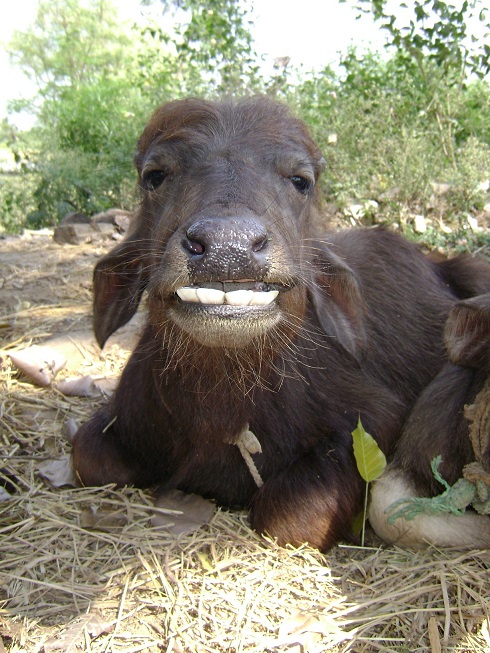
The smiling buffalo

Some funny snaps of a pair of buffaloes I encountered during one of my forays into the villages. 

The first snap . . .  A very smart pair. 
As I walked on, one of them seemed to ask me if I would like to take more snaps

And below are 3 snaps of various poses . . .


At last, he got really tired and went off to nap . . . 


Friday, April 19, 2013

3 maternal deaths . . .

 Over the last 3 days, we had 3 maternal deaths . . . 

Not much of a description . . . but I hope these are documented here.

The first one . . . Happened on Monday. We shall call her A. Brought with a breech presentation, her baby was hanging out with the head stuck inside since one whole day. She was very toxic. As we tried to take the head out, the uterus prolapsed (not inverted). The next thing we knew was that she had collapsed. None of our efforts could revive her. 

The second one . . . occurred on Tuesday early afternoon. B had delivered at a nearby PHC couple of hours back. Her referral letter showed that she had severe pre-eclampsia. But, she was gasping now. And she was in shock. We did not have any clue about what had happened. We had her intubated. But, she did not make it. Most probably, a amniotic fluid embolism. 

And the third one . . . which happened yesterday. C was admitted on Wednesday night with severe anemia (hemoglobin: 7 gm%). She had already got couple of blood transfusions elsewhere. We had induced her. The relatives arranged one pint of blood. Then she went into pre-eclampsia which we had got control of. However, the patient did not progress. The baby was going into fetal distress. We did not have a choice but to operate. 

The surgery went on well. However, she became sick soon. And then in the Acute Care, she went into a refractory Post Partum Hemorrhage. With no blood, we could only watch her die. The baby, although sick is still in NICU. 

It's terribly discouraging. But, I wonder if we could have done any better. 

The third case would have benefited if there was a blood bank at NJH. 

But, the first 2 cases. They should have come earlier. 

Another cry for better facilities and personnel in a region like ours . . .

Anybody listening ? ? ?


Miracle of the night

After quite a long period of a lull in high risk obstetrics, we've had something to cheer about tonight. 

And it was extra-special after we had a dubious record of 3 maternal deaths happening over a period of 72 hours. I shall definitely post about that later. But, before that, the cheerful item. 


If you look carefully the baby above, you'll notice that the right hand and left leg are swollen. In fact the right posterior aspect of the head is also swollen up, which was not captured in the snap. 

This baby's mother had been in active labour since late evening yesterday. Deep within the jungles of the Palamu Tiger Reserve somewhere near Garu, it took the family almost a whole day to realise that she would not deliver normally like her previous 4 pregnancies. 

The family took her to the Catholic dispensary nearby from where the sisters brought her here. 

It was a compound presentation. The right hand and left leg were already hanging out of the vagina and the head was pressing hard on it. 

We did the surgery within an hour. 

The mother is anemic. We're yet to get blood. The baby has aspirated quite a lot of meconium. 

Kindly pray that there would not be any further complications.