Tuesday, August 23, 2011

PRODIGAL SON . . . AN ATTEMPT TO COME BACK . . .

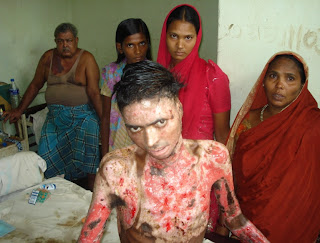
MI belonged to a lower middle class family in our nearby village of Satbarwa which was our local market. MI used to work in Mumbai. He was unmarried. And he had returned home about a month back.

MI was brought to NJH is this state on the 10th of July, 2011. The story was that he was making tea when the stove burst and he suffered burns on his upper part of the body. It was very obvious from the burns that the story was not really true – but MI and his relatives held on to their story. MI was in danger of having suffered inhalational injury. We gave a very guarded prognosis and offered to help him get shifted to Ranchi for expert treatment – which the relatives were not very keen.

In addition, there was a possibility of severe edema resulting in closure of the oral cavity and the airways at a later stage. There was very high risk of infection. However, MI and his family members consisting of his parents and 3 doting sisters – were very determined to help MI recover.

The recovery has been very painful and long. It was very helpful that the family, especially his 3 sisters have helped him to cling on to his life so far. With a burns percentage of 50%, it is amazing that he has made quite lot of ground.

However, over the 6 weeks that he had been with us in hospital, Dr Nandamani and the nursing staff has made quite an impact on the young man that the real story of his burns has come out. MI had a quite violent past. He had been an alleged drug addict for some time. Few weeks back MI’s mother had presented him with a cell phone which was worth about 5000 rupees. For the family, in the rural Indian male centric world, MI was the epitome of all their aspirations and dreams.

Unfortunately, MI was quite spoilt – indulging in all sorts of vices and in addition, allegedly falling prey to alcohol and drugs. MI sold the 5000 rupee mobile which his mother had gifted him for a paltry sum of Rs 500 to fuel his drug habit. His mother came to know about it in no time. There was a huge argument in the house following which MI poured kerosene over his head and set himself on fire. That explained for the deep burns on the back of his body.

MI has since repented and he wants to get back to his normal life. He has been going through a very painful experience which has broken him down. In addition to the pain, the treatment has been quite expensive. The family must have spent about 50,000 rupees so far in his treatment. They still have outstanding bills of about Rs 40,000. He already had two sittings of skin graftings.


MI is quite miserable about the life which he has wasted so far. I’ve assured him of putting out his story to people who could remember him in prayers as well as help him pay at least a part of his outstanding bills.

[This story was put in the blog after taking consent from MI and his family including putting photographs. There are quite a number of patients who come to us with burns for whom we have to write off quite large amounts, which puts quite a lot of financial strain on the unit. Other stories are that of VM (http://jeevankuruvilla.blogspot.com/2011/07/pediatric-burns.html) as well as that of PD (http://jeevankuruvilla.blogspot.com/2011/07/neglected-burns.html ). We plan to start a fund to help our burns patients with regular treatment and if needed additional support to restart and rebuild their lives.]

Monday, August 22, 2011

MALARIA – Or is it something else?

35 year old IS works somewhere in the Jharkhand-Uttar Pradesh border as a daily wage labourer. 4 days back, he had high grade fever with chills and rigor. He was treated for malaria by the local quack. As the fever was persisting, he thought of going back home along with one of his fellow villagers who worked along with him.


IS was brought in an almost unconscious state to our casualty sometime today afternoon. The look on his face was enough to tell us that he was gravely ill. The whole of his face was flushed, the sclera of his eyes very chrome yellow and the conjunctiva was all congested. The breathing was labored and chest examination revealed that there was quite a lot of fluid in the lungs. His liver was tender. It looked more like Weils’ disease than malaria to me.

The investigations were terrifying – the serum bilirubin came an astounding 51 mg%, the total count was in the range of 50,000, the platelets 15,000 and a serum creatinine of 4 mg%. Medically speaking, he cannot survive with the sort of facilities we have. The saving grace was that his hemoglobin is 8.9 gm%. And of course, his blood cells was teeming with falciparum malaria.

After reaching his village in Leslieganj yesterday, IS continued to have fever and he became unconscious sometime around midnight. IS’s family is very poor. The reason for IS working so far away from home was to earn a living for his family - 3 little children and a young wife. IS was brought to NJH by fellow villagers and his elder brother.

The elder brother and his villagers were aghast after we pronounced our prognosis and gave them an option of taking the patient elsewhere. As I write this, IS has pulled through so far. I’ve asked the people who brought him to arrange for blood.

In addition, I’ve started him on anti-malarials and treatment for leptospirosis. Many a time, we’ve seen that presence of malarial parasite in the blood tends to be a red herring.

After the persistant rains over the last 2 weeks, it has now become very humid – quite a good environment for the mosquitoes to breed.

We are having quite a lot of malaria than last year. After the last year, when we had lesser cases – most probably due to the drought, I have a feeling that people had started to take possibility of contracting malaria quite lightly. To compound this problem is the practice of single dose treatment by many quacks – it is not uncommon to see people who come with persistent fever after having taken a single injection of artesunate or quinine.

From my experience of 2003-04, one more condition which becomes quite common during high incidence of malaria is the occurrence of injection abscesses. Giving quinine as deep intramuscular injections is something practiced by quacks and many of them ultimately end up as big abscesses. This year, I’ve seen one where the abscess had already organized, solidified and probably fibrosed– sparing the poor sufferer of an incision and drainage surgery.

Today evening, I’ve seen one more patient, a pregnant lady who has come in with fever. Blood examination shows falciparum.

Deaths which could be directly attributed to malaria are quite less nowadays. This is mainly because many of the fever cases come after some form of partial malaria treatment. As far as I remember, almost all the patients who tested positive by smear for malaria have recovered completely.

There has been one death over the last 2 weeks – a 16 year old girl with fever. She had been treated as malaria elsewhere. She had hemoglobin of 3 gm% and was unconscious since the day she came in. She never tested positive for malaria. Most of my colleagues strongly felt thatit was malaria.

Now, this is where we need to do some sort of research on. Are we only dealing with malaria alone or are there other infectious diseases which are very similar to malaria – dengue, leptospirosis, rickettsia etc. I wish we could have help whereby we could explore more on this . . .

Sunday, August 21, 2011

DIABETES – making communities poor . . .

I remember the cold Wednesday morning in the OPD at NJH sometime in Winter 2004. There was a old man in his middle 60s sitting in front of me. He had come to NJH for his foot which was decaying. His problem was very obvious and not at all uncommon to me who came from the south of India. He had diabetes and had an ulcer in his right foot which was refusing to heal. But for NJH it was something rare. Diabetes was believed to be uncommon in this part of the country. That was the first and the only patient with diabetes whom I saw at NJH during my stinct in 2003-04.  

Fast forward to today (21st August, 2011), the last patient I saw in emergency - someone I shall call SDP. SDP has been hypertensive for quite a long time. He claimed that he is not a diabetic. His relatives even showed me a blood test which showed GRBS as 141 mg%!!! SDP has come in very sick. He has been having a angry looking swelling of the right foot and obviously he had infection - he was febrile and breathing heavily and fast. His GRBS was above 200 mg%. Obviously he must have had high sugars and somehow it was not picked up. 

In the wards, we have 3 patients who have diabetes. On an average, in the out-patient department we have about 3 new diabetic patients every week and more than a dozen of them coming for them coming for their repeat medications every week.

However, what I need to tell you about a very peculiar history that many of them give. Quite a lot of them have been diabetics for 10 years or more. So, where were they when I was at NJH in 2003-04? I've not done a detailed study on this - but have been asking quite a lot of the present patients about the same. The answers have been shocking. It seems that quite a lot of them had been frequenting hospitals at Ranchi (135 kms away) and Kolkota (12 hours by train) just for the treatment of diabetes. When I ask them about the reason they did not come to NJH - the answer was that they thought that mission hospitals are mainly for surgical management and there was no 'diabetes specialist'.


It was very unfortunate. The minimum amount of drugs which many of the 'diabetic consultants' wrote for these patients were about five and the expenses involved has been quite huge.  Many of the patients had also been misled by traditional and alternative healers for radical cures of the disease - and they had also spent quite huge amounts on them.


Quite a large number of our present diabetic patients who had been on treatment for long durations – and the treatment have literally made them paupers. And that was the reason that they started coming to us.


So, how are we going to respond? We have already planned to start a chronic diseases clinic of which diabetic management would be one of the major components. I wish we can send one of our doctors and few of our nurses for training for diabetes management. To decrease the load in our laboratory and to streamline management we are going to get a Nycocard machine for HbA1C and urine microalbumin.


As I finish writing this, Angel informs me that one of the new admissions in the ward who is a diabetic has ketoacidosis. It is ages since I’ve managed one. I fondly remember my MBBS days at Trivandrum as an intern in Medicine 2 where we honed the art of managing diabetic ketoacidosis.


Unfortunately, the major question remains on how much is rural India ready to take on the demon of diabetes and hypertension. With the requirement of regular treatment – which is a concept quite alien to the Indian psyche – there has to be major shift in the attitude of communities towards chronic diseases. We are still grappling with infectious diseases and inadequate reproductive health care. The additional burden of non-communicable diseases could quite increase the morbidity within communities, the consequences of which we may be facing sooner or later.


The concern is that, many of us, especially in the rural agrarian societies of the country do not know very clearly on what the consequences could be.  

Saturday, August 20, 2011

FLOOR PATIENTS. . . SOS

You may be wondering what this is. For graduates from private medical colleges and both the Christian Medical Colleges, I know what I’m going to talk about is unthinkable.


As I was writing articles for my blog, I got a call from Dr. Nandamani saying that there are quite a lot of patients pouring into the hospital. Since the last 3 days, all the beds in the hospital are full. Yesterday night and today morning, we have had problems with allotments of private ward rooms with patients’ bystanders almost coming to blows.

The situation in the general ward is worse. We are discharging patients quite soon now. So, as we departed for the evening, we’ve decided to make a consent sheet for patients who want to get admitted in spite of the space crunch. We thought that the wordings in the consent would turn away patients. But, I am mistaken.

So, I think for the first time after many years we have patients on the floor in NJH. I’ve heard about patients in the floor before the construction of Acute Care Unit and the new Maternity Block.

As I write this I’m reminded of my MBBS days in Trivandrum when we used to have patients on the floor. We had only about 20 odd beds each in the male and female wards and there used to about 60 admissions in each ward. So, we used to have a system of allotting floor spaces for patients. The sickest used to get the beds and as soon as they were better and if there was a sicker patient coming in the poor fellow would be demoted to the floor.


Sometimes it used to become hilarious. There have been many occasions when a ‘floor patient’ cannot be traced and then we find him/her happily sleeping under someone else’s bed. Then, there was another occasion when a patient's bystander who was taking a nap taken for clinical case session for the medical students. It was only after quite some time in the class that we knew that we had a normal fellow in front of us. Of course, he had a good snack and tea which we customarily used to arrange for patients coming for clinical case classes.


Well, anybody out there who would like to come and help us out – doctors and nurses. We have couple of more EHA units who need extra hands . . . My contact details are on the margins of this blog . . . S.O.S . . .

THE NEW VENTILATOR

As I reached NJH with the new machine, I was like a little boy waiting to open and try out his new toy - so I was waiting for the opportunity to unpack the machine and and use it. There were quite a lot of things to be settled before I could get my hands on the same. However, I was glad that I could spend about ten minutes as soon as I was a bit free. Dinesh had already unpacked the machine and had positioned it on the lower shelf of the Boyle’s machine.


I was glad to have spend some time tinkering with it because I had a patient very soon. SD (
http://jeevankuruvilla.blogspot.com/2011/08/tiring-thursday.html) who had eclampsia and a live baby was the first customer for the ventilator. I was quite impressed with the performance expect for the fact that the warning lights did not come on when the patient started to breathe on her own at the end of the surgery. The theatre nurses, Suman and co. were also quite pleased as they were free from the business of manually pumping air into the patient’s lungs. They were quite free to do other things and it was helpful when the baby arrived as we had extra hands for the resuscitation.

The ventilator was brought into action in the surgery on KD too as she was also eclamptic.

Sr. Suman with KD after the surgery


So, from the initial impression, it has been quite a worthwhile purchase for us – saving quite a lot of muscle power and giving us additional hands.


Now, I wait for a time when I can use it in the ward – where the circuit which needs to be used to quite a different one. I shall update you on the same as soon as we use it in the ward.