Sunday, May 12, 2013

Healthcare professionals

Today, The Hindu, had 2 very good articles (Frontiers without doctors, Financial muscle buys seats) about medical education in the country. 

After reading the articles, the situation looks very grim especially for Empowered Action Group states (previously termed Bimaru states)

The issue calls for emergency action by the state and the central governments. 

However, one aspect which was untouched in both the articles was the quality of medical education. 

We see the repercussions of the same in our daily practice at NJH. 

To top things up, I was amused by another article in the same paper about how the medical profession contributes to mortality. 

So, it's up to each of us to decide on what could help us better. Having doctors around us or having no doctors around us. Or having doctors around us, but using common sense and the internet to decide whether a particular treatment is necessary for us or not. 

One can only imagine who would dictate terms once doctors pass out of medical colleges after paying hefty amounts of money. So, beware of the white coat . . . 


Caring for the fetus

Today there was this news about the National Institute for Health and Care Excellence in the UK saying that midwives would will test women at antenatal appointments and those with high carbon monoxide readings will be given advice on how to quit smoking. Of course, no NHS treatment is compulsory. 


Compare this with women who will come for an abortion and are not given any advice about killing an alive and growing fetus. 


Of course, both involve the autonomy of the mother on how to treat her own body, albeit there being a second life totally dependent on her. 


Recently, I was appalled to read about how mothers could even opt out of breastfeeding if she felt that she does not feel doing so. And if she is given advice about the benefits of breastfeeding, that could amount to bullying from the nurses.


Consider the case of opting out of breastfeeding in a rural third world country. That would sound the death knell for the baby. 


Pushing down formula feeds down the throat of the baby in lieu of breastfeeding without a proper counselling is something I find totally non-acceptable. I'm told that present formula feeds are more chemically consistent with breast milk than earlier years. 


For a developing country, that's going to be really costly for the mother and I'm not sure how many towns would be able to stock them in their pharmacies. I remember one nursing staff of one of my previous work places who opted for formula feeds and ended up spending quite a lot that she found it difficult to provide for the needs of her family. This happened in spite of the hospital management giving her two additional half hour breaks to feed the baby (she lived in campus). 


Of course, I agree about situations where we ultimately resort to formula feeds. But, these situations are quite rare. In our clinical practice at NJH, we've found it very difficult to convince families to provide formula feeds in the right amounts even when it is indicated for the baby. 


Coming back to the issue of mother's smoking, there are children who are going to inhale the second hand smoke. Of course, the Institute is concerned about that too. 


I'm sure that there would be people up in arms against the decision taken. 


The silver lining is the fact that there are people out there who are not willing to accept the fact that families can turn a blind eye to the autonomy of a fetus once she's conceived. And of course, to a child who's growing up.

Thursday, May 9, 2013

Unwanted food . . .

Today morning, we were wondering at the huge number of jackfruits which was there in front of our home at Othera. There was hardly any demand for the fruit and they were falling and rotting on the ground below the tree. 


One could only watch it. No market and too much for any family to have. We were on holiday . . . so there would be a higher demand. But, not enough demand for even 10% of the fruit on the tree. 

So, it was falling down and rotting . . . 


In India, plentifulness in the midst of poverty and hunger is not something new. Especially, stories of grain rotting off in the Food Corporation of India godowns are very commonly heard in almost all states of the country. 

I've seen how vegetables and fruits are discarded as the prices they fetch are too less for the farmers. We've had instances for vegetables being sold at throwaway prices in our neighbourhood at NJH.


If one goes to buy a jackfruit in the market in Ranchi, it is never less than 30 INR per kilogram. 

But, the fact is that there is no buyer for the fruit when someone wants to sell it at the site of cultivation. 

I hope you remember my post about tomatoes going waste in Daltonganj market. Today late morning, I was at the Othera vegetable market and the cost of 1 kilogram of tomato was 50 INR. 

One solution will be form federations of vegetable farmers who will be able to command a better price and market for their produce. Today morning, I was reading about the Karnataka Milk Federation which is selling it's products under the brand 'Nandini'. We also know the story of Amul. 

Some sort of a federation which would champion the cause of vegetables is something which could go a long way in the marketing of vegetables across the country and prevent the enormous wastage that's happening.  

Wednesday, May 8, 2013

Sevagram . . . A call to simplicity

About 5 years back, I got an opportunity to visit Sevagram. This was where the Father of the Nation, Mahatma Gandhiji had his ashram. Below are some of the snaps taken during the visit. The first thing that strikes you is the stark simplicity of the place. I hope this post will be a gentle reminder about our beginnings as an independent country. 

The entrance

General view of the campus - 1

General view of the campus - 2
 
Gandhiji's bathroom

The verandah where Gandhiji used to dine with his associates

Here Bapuji used to have his sun bath
 
His wooden sandals and walking stick
Articles used by Gandhiji. The list is given below


The bed on which Gandhiji used to sleep. I hope he had a mattress over this.

Bapuji's massage table
The reading room

The vessels he used

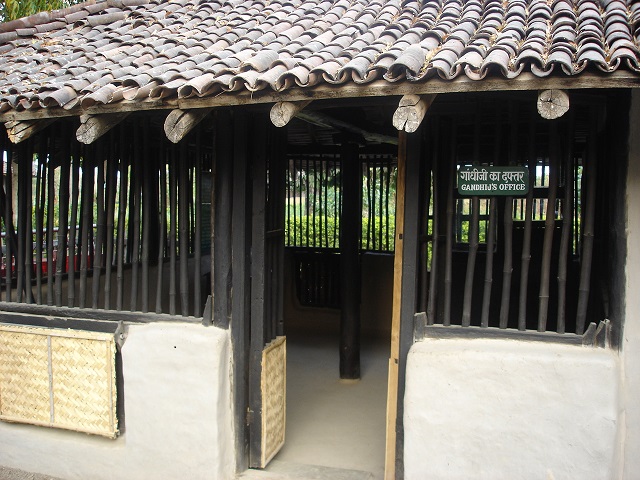
Bapuji's office

Gandhiji's telephone

It was becoming dusk as we finished the tour of the campus

The tree under which Bapuji used to sit when he addressed gatherings

The prayer ground

Life through the window

I am travelling with family by train. I took a snap of our kids sharing a window to look out. I thought the snap looked cool . . .