Showing posts with label madwa. Show all posts

Sunday, March 26, 2017

Oh . . . Ragi . . .

After quite a long time since we had been trying to reintroduce Ragi into the local diet (since 2011), we still don't have any data to prove that we've made any impact.

However, I keep hearing stories on how many more farmers grow millets in the Palamu region now.

And, on and off we get to eat ragi dishes when I visit mission stations, like the 'Ragi puttu' we were served last week at Chandwa.


I was told that this dish is relished by quite a many of the residents there.

May the tribe of ragi lovers increase . . . 

Monday, June 8, 2015

Mission Millets Cont'd

Now that we know that finger millet used to be a crop in our community some time back, we took the decision to bring back the crop into the local agriculture. 

The first initiative was done couple of days back, where we had an interaction with the farmer community. About 40 people attended, most of them women. There is a great interest especially from farmers who are a bit elderly. They've had millets during their younger age and were quite pleasantly surprised that they have abandoned such a healthy crop. 

Snap from the event .. .. .. 


Points which we garnered from the crowd - 

1. Everybody is quite aware that there is a prediction of deficient monsoon. 
2. Most of the older farmers know that finger millet requires lesser irrigation. 
3. Many of the attendees were small landholders and they were more interested in having varieties of crops in small amounts in their land. 

Below are two pamphlets we made from templates provided from NJH.  


We are excited about this. We request your prayers. Distribution of seeds will start as soon as they arrive from NJH. 

Saturday, November 15, 2014

Tale of two fields

While Professor Haider from Birsa Agriculture University visited the fields in the target villages of NJH Community Health work, we got to witness a very telling fact about millet farming.

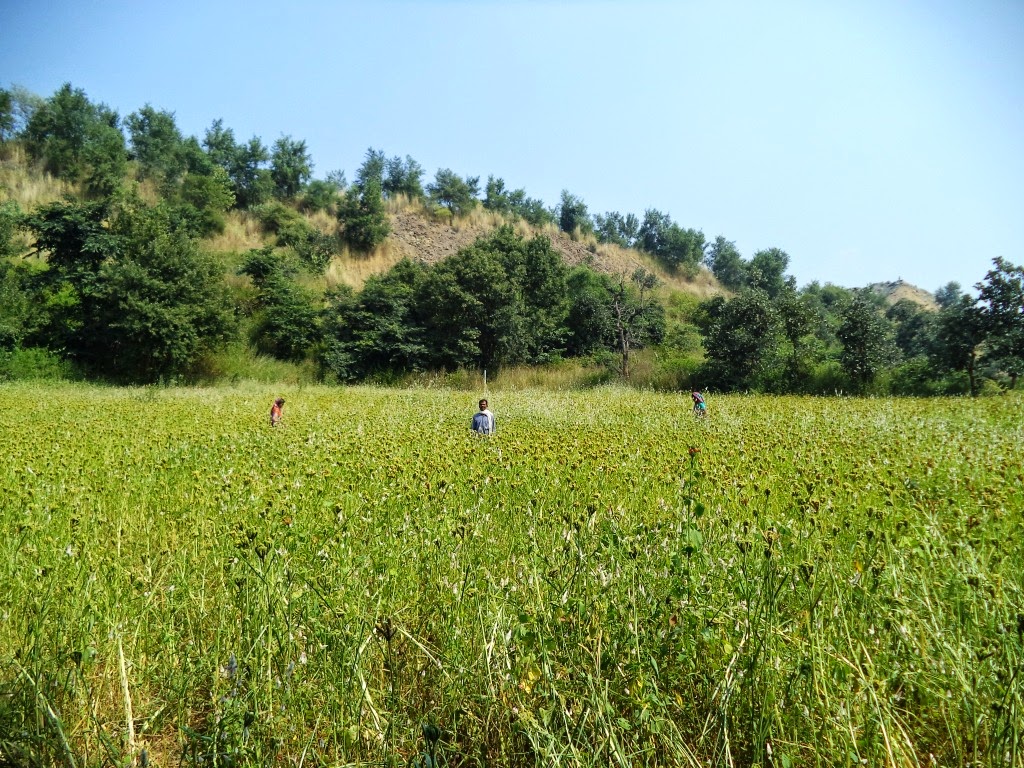
At Patna village, we got to meet a farmer who had sown 2 adjacent fields with finger millet and rice. Our staff had not noticed it. However, when Professor Haider visited the place, he pointed the obvious difference. It did not need any explanation.

The ragi field is on the right and the rice is on the left . . .

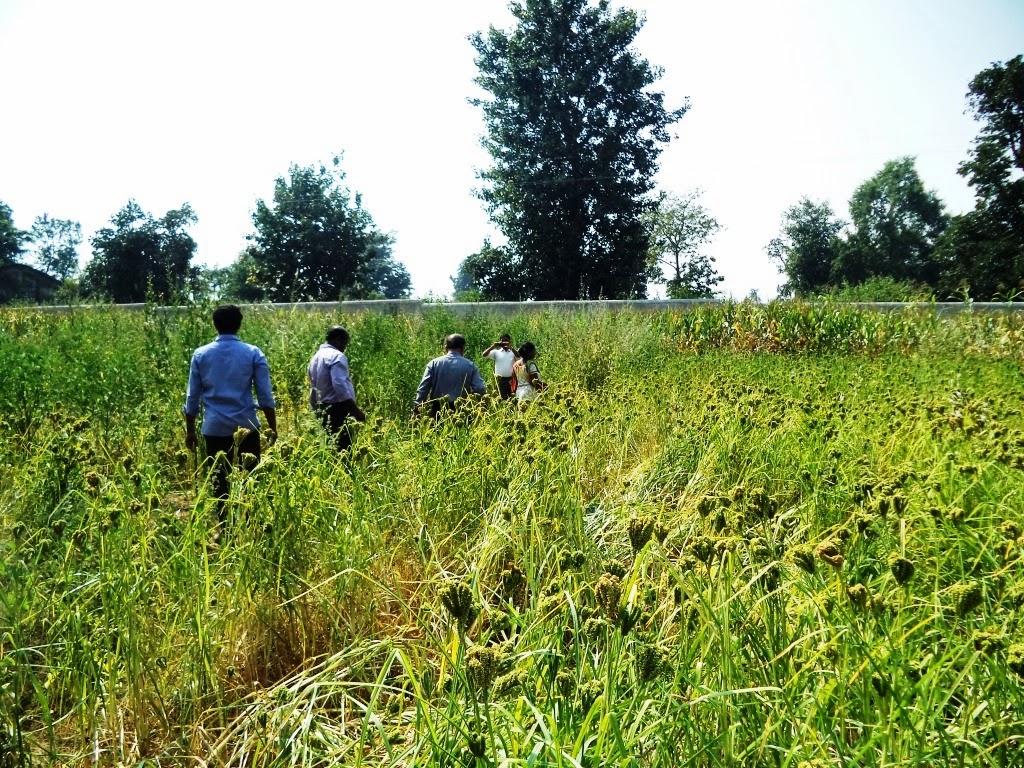
Prof. Haider and the rest of the team walking through the rice field. 
There was not even one panicle of grain in the rice field. It was in a sorry state of affairs with yellowish dwarfed slivers of leaves. The farmer told us that he had in fact given some amount of water to the rice field. However, it did not do any good. He had not tended the madwa field much. However, it was evident that he had a better than average finger millet crop.

He was happy to have tried finger-millet. He told us that he would have at least couple of sacks millet grain for the year. If he had put rice in both the fields, he would have lost everything.

Something was better than nothing.

I’m at anew place now. Here, finger millet is not much known. But, there are farmers who grow pearl millet (bajra). On interaction with patients from the nearby villages, it is very obvious that pearl millet farming is also on the way out. Farmers prefer to grow rice or wheat.


Bajra (pearl millet) at NJH. We had tried out a small plot this year and got a good yield
I’m sure it’s worth to look at the possibility of a program/project to promote pearl millet farming. Pearl millet also has many common features with finger millet, including the property of requiring less water than other crops. In addition, pearl millet is a rich source of Iron and maybe it could be the solution to Iron deficiency woes of the country.   

Tuesday, October 28, 2014

Madwa 2014 . . .

As part of our Community Development project targeting Climate Change, our team has facilitated the reintroduction of finger millet cultivation in the region. Last year (2013), we had about 40 farmers who cultivated in a total of about 4 acres. This year, we had about 230 farmers who cultivated a total of about 12 acres.

Last week, during the US-led “Dialogue on Nutrition” held at the Food and Agricultural Organization (FAO), FAO Deputy Director-General Daniel Gustafson highlighted that "good nutrition must begin with agriculture." 

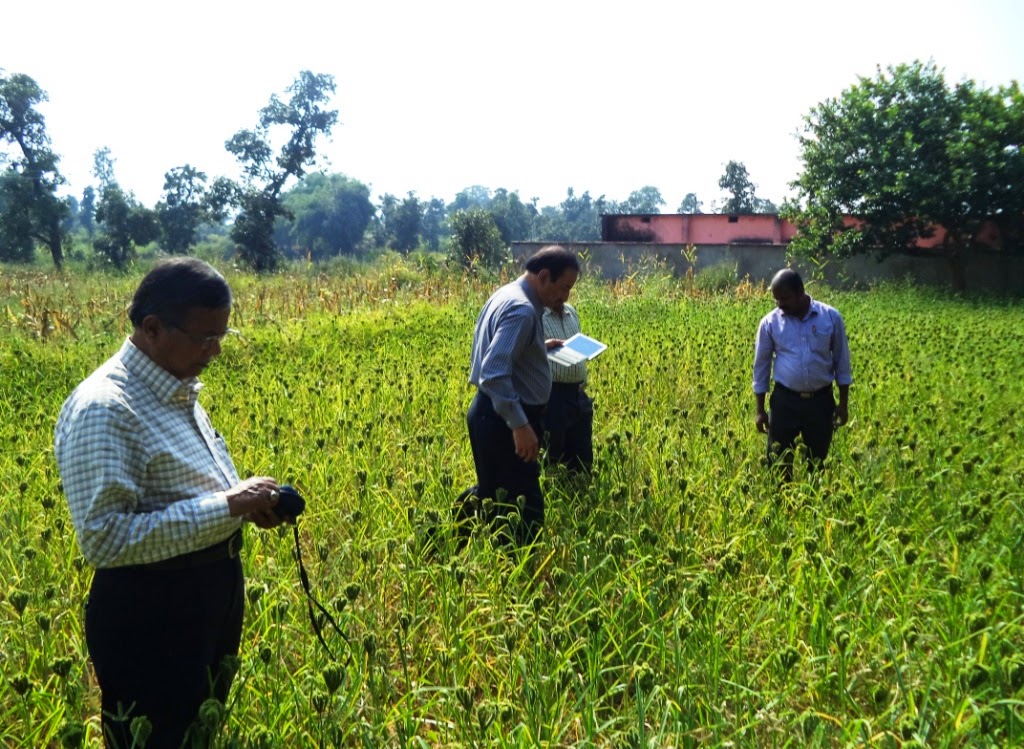
It was a privilege to have Professor Z A Haider from the Birsa Agriculture University, Ranchi visiting the region, to follow up on our work among the farmers. The program becomes all the more significant in the light of the Fifth Assessment Report of the Intergovernmental Panel on Climate Change – Impacts, Adaptation and Vulnerability. I’m yet to go through the whole report. But, from a  news-item of the same in Down To Earth, the future looks pretty grim.


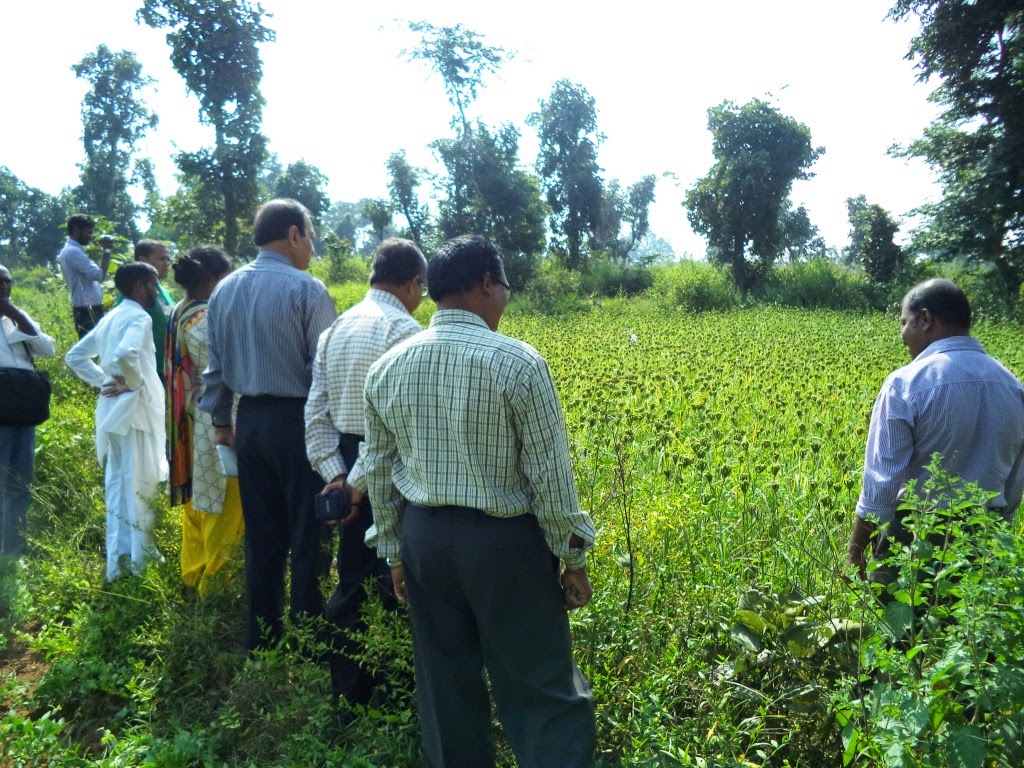
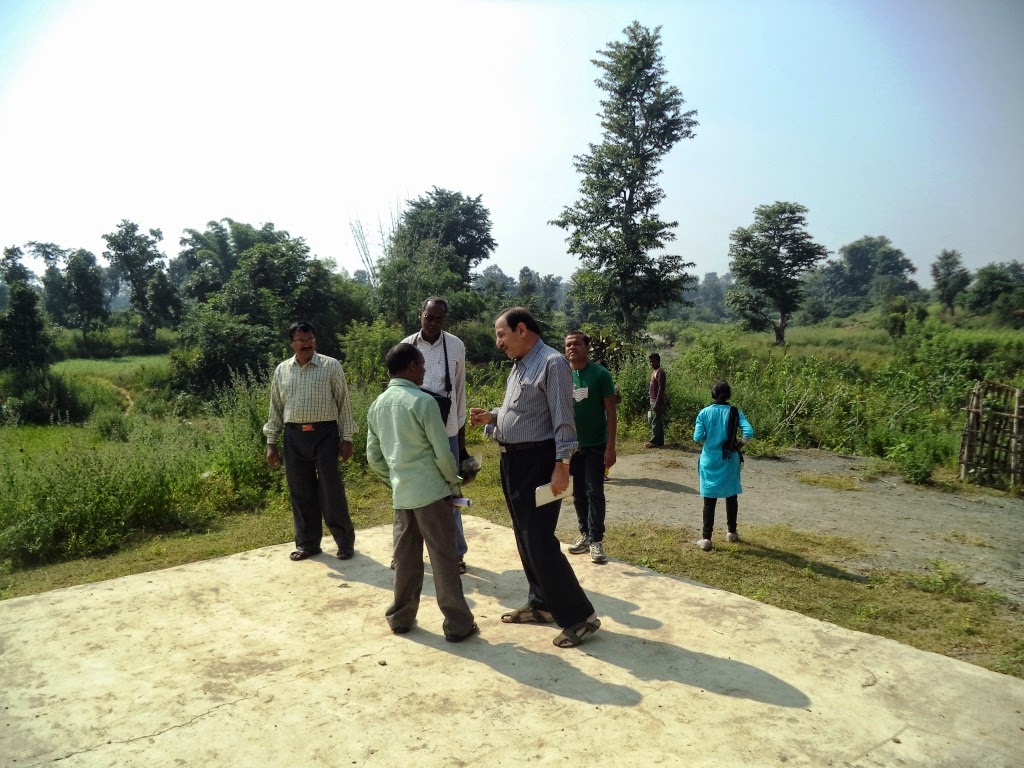
Snaps of the visit . . . and more discussions later . . .  

At Patna village . . .
Walking into the fields . . . 
Another field . . . Prof. Haider was very much impressed . . .
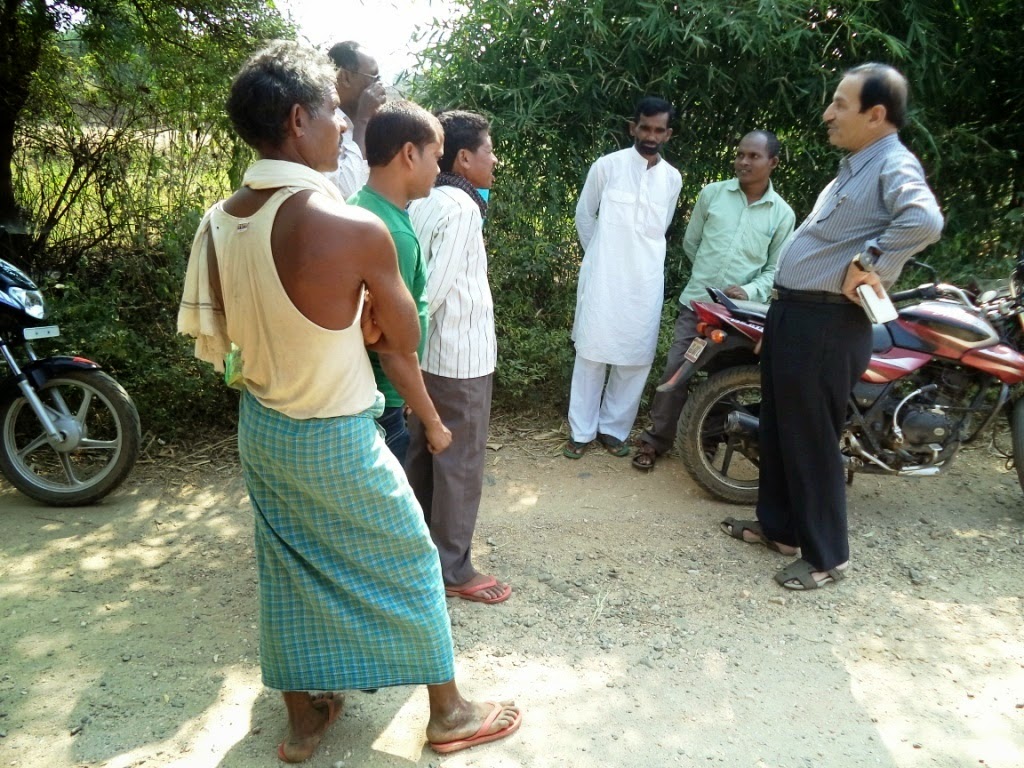
Prof. Haider interacting with the farmer . . .
This plot of ground was a major revelation for the entire team. More on this in the next post . . .
Going further . . . 
More interaction with farmers . . . 
Field at Charwadih . . . 
Quite a large field at Murma . . . 
The field at NJH campus . . .
Field at Bohita village . . . 
Interacting with people from potential new cultivation areas for the next year.
We had a very interesting dialogue. Shall write in detail about it in the next post.
Looking forward for madwa cultivation in Barwadih block next year. 

Monday, January 20, 2014

Photo Post, 20 Jan, 2014

Miscellaneous snaps from NJH . . .


We had a 1 year old child come down in shock after becoming dehydrated from severe diarrhoea. We had to put in an intraosseous line. We found out that the line would flow if there was a bit extra pressure. The best way to attain that was to put the intravenous bottle as high as possible. The intervention worked well and the boy survived. Dr. Koshy from Baptist Hospital, Tezpur helped us over phone to put in the line. 
The harvest from the Ragi fields and SRI Rice fields are finally over. One of the farmers gifted us about 8 kilograms of the finger millet. The farmers who worked with us produced a total of 5 tonnes of paddy from about 4 acres and about one tonne of finger millet from about 5 acres. Of course, the yield can be more, but it was unbelievable when the farmers told us that they got about 1.5 tonnes of paddy more than what they usually got. Nobody remembers about previous finger millet productions as it's quite some time since anybody had done finger millet farming in this region. 

Pilatus enjoying the warmth of the library (doctor's duty room)

We've a traditional healer in Satbarwa village who's quite well known for his treatment of strokes. I know this guy and has heard that he treats his patients with an extract of garlic. Only recently, I saw the medicines that he prescribes for his patients. There was one branded preparation of Ashwagandha extracts, then one packet of unidentified medicines and a orangish fluid which was supposed to be injected once a week for 6 weeks. The total cost 1300 INR. This was brought to us by one patient with Bells's palsy. She came to us for a second opinion after seeing this traditional healer. She was a bit concerned about the orange colored potion which was to be given as an intramuscular injection.

Our almost completed water tank. It's about 75 feet tall. Last Sunday, I took a trip to the top. 

I took some snaps which I shall put up in a later post . . . The view from the top is awesome . . .

Finger Millet Recipes Book

As part of the Climate Change project activity of promoting use of millets, we've come out with a finger millet recipe book. 

Below are the pages from the first draft. Would love suggestions . . . The size of the paper is A5 (half that of A4)


The English version of the recipe book is in various parts of my blog. Please click the links below for the respective recipes . . .

Monday, December 23, 2013

Madwa Laddoo


Another one of the various local delicacies made from Ragi/Finger Millet/Madwa


Madwa Laddoo . . . This is the local name. 

I don’t know what it should be called in English. 

I could call it ‘FINGER MILLET DUMPLING’.

THE RECIPE . . .

Ingredients

Finger millet flour: 2 cups
Lukewarm water: 3 cups
Cooking oil: 4 teaspoon
Salt: To taste
Diced medium sized onion


Method
 
Make dough out of the finger millet flour, lukewarm water and salt. Make elongated balls of approximately half inch length as shown in the picture. 


Arrange sticks at the bottom of a wide mouthed vessel such that there is space for some amount of water below the sticks. See the snap. 


Lay a leaf (preferably banana leaf) or muslin cloth on the top of the twigs that are arranged. Ensure that the water do not touch the sticks. Boil the water inside the vessel.


Once the water is boiled, carefully arrange the elongated balls of the dough on the leaf or muslin cloth. Steam the dumplings for about 10-15 minutes. We had tried to do this with a idli cooker. Surprisingly, the results were quite different to the traditional method of steaming.


In another vessel, heat 4 teaspoons of oil. Put the diced onion and fry till golden brown.
Add the ragi balls to the onion and heat for about 3-4 minutes.


These dumplings taste well with tomato sauce.