Showing posts with label disability. Show all posts

Tuesday, December 10, 2013

Disability Day Celebrations - Daltonganj

Now, these are snaps I got from the International Day of People with Disability celebrations in our district headquarters which our Community Health team organized . . .

Welcome address

Joint inauguration

One participant singing a song

Chottu and Chintu doing a dance
 
Disabled friendly ramp

The Climate Change Project staff advertising Madwa/Ragi foodstuff

Another view of the audience

A drama in progress

One more view of the audience

Disability Day Celebrations - NJH

December 3rd is celebrated as International Day of People with Disability. 

Snaps from the program we arranged in the hospital . . .

Registration of participants

The venue

Students from the Carmel Asha Kendra, Latehar who presented cultural programs

Disabled friendly . . . overcoming barriers

The chief guest, the Block Development Officer, Mr. Jha

Honoring the Pradhan family . . . for their commitment to tackle blindness in the community. Dr. Pradhan was operating and could not make it. Mrs. Pradhan accepted the memento.   


Scenes from dance presented by the Carmel Ashakendra students . . .


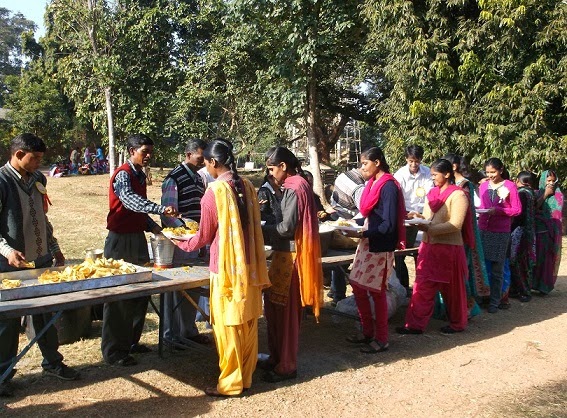
The program ended with a sumptuous lunch for participants and hospital staff and students

Tuesday, August 13, 2013

Disabled in rural India

Last week’svisits to the villages have been to look at the work that has been going on as part of our Community Based Rehabilitation of the Disabled.

Below are few of the major aspects about the disabled in rural India which sets them apart from their counterparts in towns and cities.

1.       The hardworking villagers in the rural parts of the country do not have much time to think about the disabled in their communities. The classic story is that of our enquiry about the number of disabled in our nearby villages and our staff replying that it would be a surprise if we cross a single digit number. Now, after the end of a survey, the number stands at over 800. I still have reasons to believe that we’ve still some more numbers to count.

2.       The disabled are thought of as being an aberration in the community. Therefore, no thought is given about any of their welfare. Many of the villages we visited, the villagers were quite inquisitive about the reason why we were interested in the disabled. According to them, the normal people in the village had so much of issues with poverty and under-development that the disabled who are of no apparent use was of not much of a value.

3.       The worst group of sufferers are the mentally challenged. There are lot of beliefs and myths associated with psychiatric illness. One wretched practice is that of marrying off the mentally challenged with the belief that it would make them well. It was heart-wrenching to see them being made to perform like jokers in few of the villagers.

4.       In impoverished communities as ours, the very thought of getting some money in the form of a disability pension is quite music to the ears of many a family. However, the benefit hardly reaches the beneficiary. Rather it is used off by the other members of the family.

5.       The mortality rates of the disabled are quite high. The village headman (mukhiya) who took us around had a child who died few years back. And death within the disabled populations is well accepted. It’s rather seen as grace for their lives.

6.       One major cause of disability is birth asphyxia caused by home deliveries. In fact the mukhiya’s child appeared to have cerebral palsy as a result of birth asphyxia. I wonder if someone can do a study on the burden of birth asphyxia caused by home deliveries in the community. When birth asphyxia happens and the baby dies, nobody bothers as it is deemed that the baby was weak (kamjor) and therefore it was good that the baby did not live and suffer for the rest of his/her life.

7.       In the midst of all these, there are isolated amazing stories of the disabled being able to stand on their own feet. There was this young man in the village we visited last week, who was disabled because of polio. But, he was quite motivated, hard-working and was into dairy business. He had his own vehicle which he used to ferry milk from the village to the nearby town.

The final word – The disabled in rural India hardly finds any acceptance, leave alone any sort of support from their fellow human beings. There is a lot to be done to mainstream them into the society. Considering into fact the healthcare issues in rural areas which are yet to be well taken care of, it may seem quite a tough and humongous task.


However, I’m encouraged by the efforts that our team has been able to put through in reaching this marginalized group. We value your prayers, support and advice. 

Saturday, August 10, 2013

Village Visit - Latehar District (1)

Last week, we had a supervisory visit to Latehar district as part of the Community Based Rehabilitation of the Disabled. The scenery of the villages we visited was awesome. Few snaps from the visit. 

I had real difficulty in selected the best snaps . . .

A river through which we had to wade across.

Sr. Banosa, Rachel, Sunita along with villagers walking back

The stunning snaps of the rice fields. The hills of Mahuadand are in the background.

A small lake which we saw on the way . . .

Snap through the windshield of the jeep. 

Rice grown by the Systemic Rice Intensification method. 

The visits included long walks through such paths . . .

A snap which I got on the drive back . . .
Amazing . . . isn't it? 

The snaps are quite evident of how beautiful the place is. 

Thursday, March 21, 2013

Community Based Rehabilitation

This is a guest post written by my colleagues, Ms. Rachel Belda Raj who serves as a Project Officer in the Community Based Rehabilitation Project. This is in response to mails from readers about what Community Based Rehabilitation exactly is. Ms. Rachel is a Masters in Social Work from the Madras Christian Collge and has served at the Physical Medicine and Rehabilitation Department, Christian Medical College, Vellore before joining NJH


Disability has been an age old problem in our societies and would continue to be present. People with Disabilities(PWDs) have always been excluded from the mainstream society. As human rights developed, PWDs started raising their voices for their rights but it has been limited to the educated society who are aware of their rights but the majority continue to live in ignorance of their rights and under discrimination. But approaches to disability have evolved and view of disability have changed from giving charities to a medical perspective and finally to an empowerment model. Hence the development of the Community Based Rehabilitation.

The Community Based Rehabilitation Project, as the name suggests involves in working in the community using the community resources as opposed to an institutional based rehabilitation where more focus is on the medical condition. Hence, CBR involves Persons With Disabilities (PWDs), along with their families, community they live in and the respective government including policy makers and implementers. The dream of the CBR project would be to facilitate a just society where PWDs are given equal opportunities in all spheres of life. The first step towards this goal would be for PWDs to know and access their rights and move forward into the mainstream society.

This project facilitated by Nav Jivan Hospital is the first of its kind in the area and covers a area of 10 blocks with a population of approximately 1.5 million. The initial feel from the field reveals that ideas about disability are still very raw. Therefore a community based project would be a good start in dealing with disability in the area. 

Tuesday, December 11, 2012

Disability Day at NJH . . .

The Community Health Team at NJH observed the World Disability Day today. The day is officially celebrated on December 3rd. But, logistics demanded that we celebrate it on today. It was a grand success.

For a place like NJH, we have discovered that the issue of disabled people being brought to the mainstream is quite a new thing. There is so much to be done. It was more than couple of years back, when we started asking questions about people with disability in the communities we served in. 

What did we find - - - 

1. Very few knew about the disabled in the community. I asked for numbers from my colleagues in the Community Health department. After 2 weeks, they told me that there must be a maximum of 20 people with disabilities in the whole block (the total population of Satbarwa block is approximately 60,000). Then about a month later, the staff told me that there will not be more than 40 people in the block. By God's grace and help from our team at Community Health Central Office, we got couple of projects for the disabled. An official house to house survey started in the block. So far, we've already crossed 800 people with disabilities in the block. I'm sure we'll find more. 

2. The next question we asked was about their well being. Nobody thought that anything good would come out of a person with disabilities. One of our retired staff had a daughter with special needs. Everybody talks in hushed voices about her. It was quite a sight to see her all cleaned up and interacting with our staff after we intervened. There was another boy with hearing impairment . . . the parents could not believe us when we told them that the boy can achieve quite a lot in life. And his home was on the lane bordering the hospital boundary. 

3. The last thing we found out today. In the whole block, there were only 17 disability certificates issued till date. And almost all of them were above the age of 50 years. And the last one was issued quite a long time back. 

We know that we can make an impact in the region on the lives of the disabled. 

Of course, the snaps from the program today. 

Students with special abilities from the Carmel Asha Nivas, Latehar present the welcome song

The Civil Surgeon, Palamu - Dr. Gopal Shrivastava addressing the gathering

Lighting the lamp. 

A song sung by the people with disabilities from our neighbouring villages

A dance presented by children with disabilities from the Carmel Asha Nivas, Latehar

The audience enjoying the proceedings
In communities such as ours where basic issues like neglect of women and children continues to beg attention, our efforts in mainstreaming the disabled is going to be a major challenge. We request your prayers and well wishes as we serve.